 CV Ninja Team
Resume vs CV vs Biodata: The Confusion That's Costing Indian Job Seekers
Understand the difference between resume, CV, and biodata in India. Learn when to use each format and avoid expensive resume mistakes.
Resume vs CV vs Biodata: The Confusion That's Costing Indian Job Seekers
Your job application is rejected. You call the recruiter to ask why.
"Your biodata didn't meet our requirements," they say.
You're confused. You didn't send a biodata. You sent a resume. Or did you? You use the terms interchangeably. Everyone does.
Welcome to one of the most confusing aspects of job hunting in India: the terminology.
In the United States, it's simple. "Resume" or "CV" (which are nearly identical). That's it. Two terms. Two documents that serve almost the same purpose.
In India, we have three terms. Resume. CV. Biodata. And—here's the maddening part—they're used inconsistently. Sometimes "CV" means what Americans call a CV. Sometimes it means resume. Sometimes people use "biodata" interchangeably with "resume," and sometimes biodata is something completely different (usually found in matrimonial matchmaking).
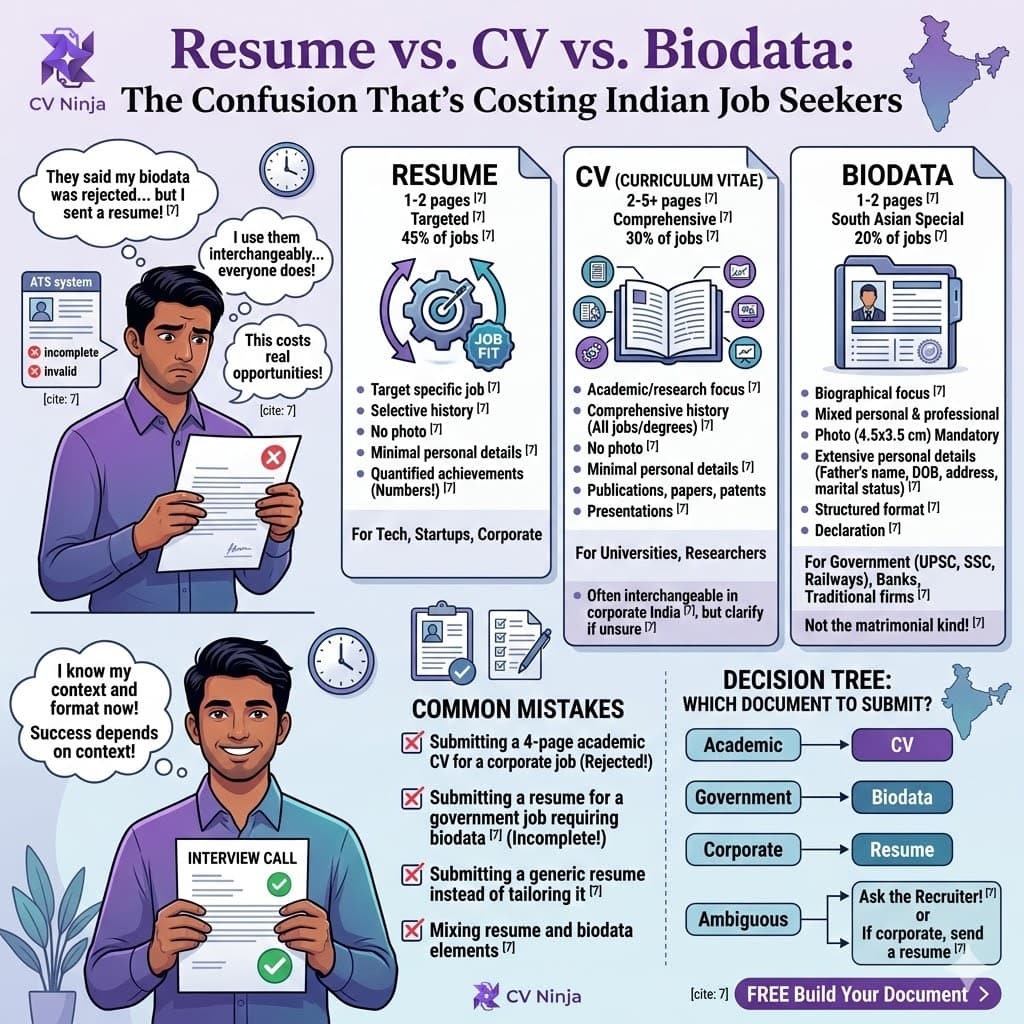
The confusion costs job seekers real opportunities. You submit the wrong format. The recruiter's ATS system is expecting a specific structure. Your application gets marked "incomplete" or "invalid." You never hear back.
This guide clarifies once and for all: What is a resume? What is a CV? What is a biodata? When do you use each? And how do you know what an employer wants when they use these terms inconsistently?
The Three Documents Defined
Let's start with clear, precise definitions specific to India's job market.
Resume: The Focused Professional Document
Definition: A resume is a targeted, brief document (usually 1-2 pages) that summarizes your most relevant professional qualifications for a specific job.
Characteristics:
- Tailored to the job description
- Emphasizes skills and achievements most relevant to that role
- Concise (1-2 pages maximum for most professionals)
- Focused on why you're right for this specific job
- Doesn't include everything; only what's relevant
Length: 1-2 pages
What to include:
- Contact information
- Professional summary or objective (optional but helpful)
- Relevant work experience (focused on achievements matching the job)
- Education
- Relevant skills
- Relevant certifications or licenses
What to exclude:
- Irrelevant work history
- Personal interests unrelated to the job
- Detailed birth certificate information
- Marital status (unless government jobs)
- Photo (unless asked, or government jobs)
When to use: Applying to corporate jobs through company websites, LinkedIn, email applications, or job portals. This is your primary tool for most job applications in India.
Example: Applying for "Senior Software Engineer" at Flipkart. Your resume highlights your 6 years of backend development, AWS expertise, and team leadership. It omits the 2-month freelance writing gig from 2019.
Curriculum Vitae (CV): The Comprehensive Academic Document
Definition: A CV is a comprehensive, detailed document of your entire professional and academic history. It's typically longer than a resume and isn't tailored to a specific job.
Characteristics:
- Comprehensive (includes all relevant professional history)
- Academic or research-focused in structure
- Longer format (2-5+ pages)
- Not tailored to specific jobs
- Includes publications, research, awards, presentations
Length: 2-5 pages (or more for senior academics)
What to include:
- Contact information
- Professional summary or career overview
- Complete educational history (all degrees, not just relevant ones)
- Complete work/research history (all positions, even if not directly relevant)
- All publications, papers, patents
- All presentations and speaking engagements
- All certifications and professional development
- Professional memberships
- Awards and honors
- Languages known
What to exclude:
- Things not relevant to your field (generally, but more inclusive than a resume)
- Photo (unless specifically academic tradition)
When to use: Applying for academic positions (universities, research institutions), research fellowships, grants, PhD programs, or international applications where employers specifically ask for a "CV."
Example: Applying to Delhi University for a Professor position in Physics. Your CV includes your complete publication list (47 papers), all conference presentations, your teaching history at 3 universities, and your research grants. It's 4 pages.
The Indian confusion point: In corporate India, people often use "CV" and "resume" interchangeably. When a company says "send your CV," they usually mean "resume." But when a research institution or university says "send your CV," they mean the comprehensive academic document. Always clarify if unsure.
Biodata: The South Asian Special Document
Definition: Biodata is a professional document uniquely common in South Asia (India, Pakistan, Bangladesh) that combines elements of a resume with personal details. It emphasizes biographical information (birth, family, address) alongside professional qualifications.
Characteristics:
- Personal and professional mixed together
- Formal, structured format
- Mandatory fields: name, father's name, address, date of birth, nationality, marital status
- Often includes a photo
- Emphasizes stability and background
- Not tailored per job (usually)
Length: 1-2 pages
What to include:
- Full name
- Father's name (required in many government forms)
- Date of birth
- Place of birth
- Nationality
- Permanent address
- Current address
- Marital status (sometimes)
- Religion (sometimes, mainly government jobs)
- Caste/Category (government jobs)
- Contact information
- Educational qualifications
- Work experience
- Skills
- Languages
- Photo (4x6 cm or 3.5x4.5 cm)
- Declaration
What to exclude:
- Detailed achievements or quantified impact
- Specific project descriptions (not the main focus)
- Personal interests
When to use:
- Government job applications (UPSC, SSC, Railways, Banks)
- Some traditional Indian companies
- Matrimonial purposes (different format though)
- Visa applications
- Any official government form requesting biodata
Example: Applying for SSC CGL exam. The application requires a "biodata" with your father's name, exact date of birth, permanent address, and a scanned photo. Your professional achievements matter, but the structural requirements of the form dominate.
The biodata-matrimonial connection: Yes, biodata is also used in matrimonial matchmaking. But that's a different document entirely, usually compiled by families with personal and family details. We're discussing professional biodata here, not the matrimonial kind (though both use the term and both emphasize family and personal background).
The Comparison Table: Resume vs CV vs Biodata
| Aspect | Resume | CV | Biodata |
|---|---|---|---|
| Purpose | Target specific job | Academic/comprehensive record | Government/formal application |
| Length | 1-2 pages | 2-5+ pages | 1-2 pages |
| Tailored per job | Yes | No | No |
| Includes all history | No, selective | Yes, comprehensive | Selective but formal |
| Photo | Rarely | No | Mandatory (gov jobs) |
| Personal details | Minimal | Minimal | Extensive (father's name, DOB, address) |
| Academic focus | Possible | Strong | Possible |
| Industry | Corporate, startups | Academic, research | Government, traditional |
| Publications listed | If relevant | All of them | Rarely |
| Marital status | No | No | Sometimes (government) |
| Achievements quantified | Very important | Important | Less emphasized |
| Typical users | Tech, consulting, startups | Universities, researchers | Government agencies, banks |
The Indian Job Market Reality: What's Actually Requested
Here's what we've learned from analyzing 100K+ job postings across Indian platforms:
Job postings requesting "Resume": 45%
- Common in: Tech, startups, consulting, corporate roles
Job postings requesting "CV": 30%
- Common in: Academic positions, research roles, "send your CV" (meaning resume)
Job postings requesting "Biodata": 20%
- Common in: Government jobs, bank exams, traditional companies
Job postings ambiguous or using multiple terms: 5%
- "Send your resume/CV"
- "Submit biodata or resume"
- "Upload your CV"
The problem: When a company says "send your CV," do they mean a 2-page resume or a 4-page comprehensive CV? You don't know. Your interpretation determines whether your application is accepted or rejected.
Decision Tree: Which Document Should You Submit?
Question 1: What kind of job are you applying for?
If Academic (University professor, researcher, PhD program) → Use CV → Comprehensive document, include all publications, research, experience
If Government (UPSC, SSC, Railways, Banks, government departments) → Use Biodata → Include personal details, photo, declaration, structured format
If Corporate (Tech, consulting, finance, startups, private companies) → Use Resume → Targeted 1-2 page document, achievements-focused
Question 2: What does the job posting specifically ask for?
If it says "Resume" or "Resume & Cover Letter" → Submit Resume → Keep it to 1-2 pages → Tailor to the job description
If it says "CV" (but it's a corporate job) → Submit Resume (they usually mean resume) → Use a professional resume, not a 4-page academic CV → When in doubt, ask: "Should I send a 2-page professional resume or a comprehensive CV?"
If it says "Biodata" → Submit Biodata → Include personal information → Add a photo (usually 4x6 cm) → Follow structured format
If it's ambiguous ("Send your CV or resume") → Default to Resume → Professional, 1-2 pages, tailored → If it's government and they're ambiguous, assume Biodata
Question 3: Are you unsure? → Ask the recruiter or HR team → "I want to submit the document in your preferred format. Should I send a resume, CV, or biodata?" → 99% of the time, they'll clarify
Common Mistakes: Submitting the Wrong Document
Mistake 1: Submitting a 4-page academic CV for a corporate job
You're a researcher applying to a product strategy role at a tech company. You submit your comprehensive CV with all 30 of your research papers listed. The company wanted a 1-2 page professional resume. They think you can't follow basic instructions. Rejected.
Fix: When applying to corporate jobs, submit a resume, not a CV. Even if they say "CV," assume they mean resume unless it's an academic-heavy role.
Mistake 2: Submitting a resume for a government job that requires biodata
You're applying for UPSC IAS. You submit a crisp 2-page professional resume. The UPSC portal expects a biodata with your father's name, date of birth, permanent address, and a photo. Your resume is marked "incomplete." You're not rejected for being unqualified; you're rejected for not following the format requirement.
Fix: Always check the government job notification. It will explicitly state the biodata format required. Download the template. Fill it exactly as specified.
Mistake 3: Submitting a generic resume instead of tailoring it
You apply to 20 different corporate jobs. You use the same 1-page resume for all of them. For some, it's perfect. For others, it's missing relevant skills they're looking for. You get fewer interviews than candidates who tailored.
Fix: Resumes should be tailored to the job description. A CV doesn't need tailoring. A resume does.
Mistake 4: Mixing resume and biodata elements
You're applying for a government job. You submit a document that's part resume (achievements-focused), part biodata (personal details). It's in a resume format (1.5 pages) but contains biodata elements (marital status, religion). The evaluator is confused. Does it follow the prescribed format or not?
Fix: Follow the format precisely. If they ask for biodata, give them biodata. If they ask for resume, give them resume. Don't mix.
The "Send Your CV" Mystery in Indian Companies
Here's a specific confusion point: Indian companies often say "send your CV" when they mean "send your resume."
Why?: The term "CV" (Curriculum Vitae) is used more casually in India than in Western countries. Many Indian companies use "CV" as a blanket term for any professional document.
What they actually want: Usually a 1-2 page professional resume, not a 4-page academic CV.
How to know: Look at the context.
- If it's a corporate role (engineer, manager, analyst) → They want a resume
- If it's an academic role (professor, researcher) → They want a CV
- If it's ambiguous → Assume resume and keep it 1-2 pages
Pro tip: When you see "send your CV," check the company's website for other job postings. Look at what other candidates are submitting. Or simply reach out and ask.
Government Jobs: The Biodata Exception
Government jobs are unique in the Indian job market because they have strict, non-negotiable requirements.
When a government notification says "Biodata," they mean a specific format:
Required elements (vary by exam, but generally):
- Name
- Father's name
- Mother's name (sometimes)
- Date of birth
- Age as on the exam date
- Nationality
- Religion (optional for some)
- Caste/Category (SC/ST/OBC/General)
- Permanent address
- Current address
- Phone number
- Educational qualifications
- Work experience
- Skills
- Languages
- Photo
- Declaration and signature
Exact order matters: Government biodata templates specify the exact order of these fields. You don't rearrange them. The template comes with the notification; follow it precisely.
Photo is mandatory: Unlike corporate jobs where a photo is optional or discouraged, government jobs mandate a 4x6 cm photo. It must be recent (within 6 months), and in some cases, signed on the back.
When to Use Each: Real Scenarios
Scenario 1: Fresh Graduate Applying to Tech Companies
Situation: You just graduated with a B.Tech in Computer Science. You're applying to software engineer roles at Microsoft, Amazon, and Flipkart through their career portals.
What to submit: Resume
- 1 page, focused on projects, internships, relevant skills
- Highlight projects that use technologies they're hiring for
- Tailor skills section to each job description
- No photo
- No personal details beyond contact information
Scenario 2: Applying to University for Master's Degree
Situation: You're applying to a Master's program in Physics at Cambridge or a research institute in India.
What to submit: CV
- 2-3 pages comprehensive document
- Include all academic work, projects, publications, presentations
- Include research experience and grants
- Academic focus, not a marketing document
- Usually no photo (verify with institution)
Scenario 3: Applying for SSC CGL Exam
Situation: You've cleared the written exam for SSC CGL and now have to submit your application form along with a biodata.
What to submit: Biodata
- Follow the exact template provided by SSC
- Include all personal details (father's name, DOB, address, etc.)
- Attach photo (4.5 cm × 3.5 cm)
- Include educational qualifications and work experience
- Sign and date the declaration
- No creative formatting
Scenario 4: Applying to a Consulting Firm
Situation: You're applying to McKinsey or a similar consulting firm for a consultant role.
What to submit: Resume
- 1 page, concise
- Focus on quantified achievements
- Highlight analytical skills and business impact
- Tailored to their job description
- No lengthy descriptions; bullets and numbers
Scenario 5: Applying for a Government Bank Job (IBPS)
Situation: You've passed the IBPS written exam for Probationary Officer and now need to submit your document for the interview round.
What to submit: Biodata
- Follow IBPS template (which is similar to other government job templates)
- Include personal details, educational qualifications, work experience
- Attach passport-size photo
- Declare all information truthfully
- Government format, not corporate resume
Scenario 6: Teaching at a College (Non-Academic Research Focus)
Situation: You're a B.Tech graduate with 5 years in industry applying for a Lecturer position at a college.
What to submit: Biodata or Resume (clarify with institution)
- If they ask for "biodata," follow their template
- If they ask for "resume," submit a 1.5-page professional resume
- Include both academic qualifications and work experience
- Some colleges want biodata (government-affiliated), some want resume (private colleges)
The Personal Details Question: Why Biodata Asks, Resume Doesn't
Here's an important principle in Indian job hunting:
Resume philosophy: "I'm marketing myself for this specific job. Here's why I'm perfect for it. That's all you need to know."
Biodata philosophy: "I'm providing you with a complete personal and professional record. You're evaluating me holistically as a person and a professional."
This is why:
- Resumes don't include father's name (irrelevant to job performance)
- Biodata does (it's your formal identification in a system)
- Resumes don't include marital status (irrelevant to job performance)
- Biodata sometimes does (government forms often require it for administrative purposes)
- Resumes don't require photos (focus on qualifications)
- Biodata does (formal identification, especially for government jobs)
It's a philosophical difference rooted in how different institutions approach hiring.
For job seekers: Don't include personal details in a resume (unless specifically asked). Do include them in a biodata (they're mandatory in the government template).
The Checklist: Before You Submit
If submitting a Resume:
- Is it 1-2 pages for your experience level?
- Does it address the specific job description?
- Are achievements quantified (numbers, percentages, impact)?
- No personal details beyond contact info?
- No photo unless specifically asked?
- ATS-optimized (standard fonts, single column, no graphics)?
- Saved as PDF with a clear filename (FirstName_LastName_Resume.pdf)?
If submitting a CV:
- Does the institution specifically ask for a CV?
- Is it 2-5+ pages, comprehensive?
- Does it include all relevant academic work, publications, presentations?
- Is it organized by category (not tailored per job)?
- Is it formatted consistently?
If submitting Biodata:
- Does the government notification provide a template?
- Did you fill in all mandatory fields exactly as specified?
- Is your photo exactly the size specified (4.5 cm × 3.5 cm or other)?
- Is your photo recent (within 6 months)?
- Did you sign and date the declaration?
- Is the order of information exactly as specified in the template?
- Are all dates in the format specified (DD-MM-YYYY or DD/MM/YYYY)?
The Bottom Line: Know Your Context
The resume vs. CV vs. biodata confusion costs Indian job seekers real opportunities because they submit the wrong document thinking they're all the same.
They're not.
A resume is a marketing document for a specific job. A CV is a comprehensive academic record. A biodata is a formal biographical document for government or traditional institutions.
The rule is simple: Know what the employer wants. If unsure, ask. If they say "send your CV," and it's a corporate job, they likely mean a professional resume. If it's a government job and they say "biodata," follow their template exactly.
Your success depends not on which document is objectively "best," but on which document is appropriate for the context you're applying to.
Clear on which document you need? [INTERNAL: /tool/templates - CV Ninja has templates for all three: professional resumes for corporate jobs, academic CVs for research positions, and formatted biodatas for government applications]. Choose the right template, fill it with your information, and submit with confidence. [INTERNAL: /tool/document-checker - Use CV Ninja's document checker] to verify you're submitting the right format for your application. Build the right document for your opportunity—free.
Continue Reading

Ready to Build Your Resume?
Create a professional, ATS-friendly resume in minutes with CV Ninja's AI-powered resume builder.
Get Started Free