 CV Ninja Team
How to Write a Resume With Zero Experience: A Fresher's Survival Guide
Complete guide for freshers to write a powerful resume with no work experience. Learn how to turn college projects, internships, and skills into interview calls.
How to Write a Resume With Zero Experience: A Fresher's Survival Guide
The placement season is in full swing. Your college's placement office sent out an email: "Recruitment drive next week. Submit your resumes by Friday."
You open a blank Word document. You type your name. And then... you freeze.
Your cursor blinks. You have nothing to put down. No job experience. No "managed a team" story. No "increased revenue by 300%." You're 22 years old with a degree in Computer Science and absolutely zero professional experience.
Sound familiar?
If you're reading this in early 2026, you're part of a cohort of 8 million+ graduates who enter India's job market every year. The Ministry of Education says 42.6% of them are "employable"—which means roughly 4.5 million are not. The gap isn't about intelligence or potential. It's about how you present yourself.
Here's the brutal truth nobody tells you: Hiring managers don't expect freshers to have work experience. They're not looking at your resume thinking, "This person has never managed a multi-million rupee project. Reject." They're looking for something else entirely: evidence that you can learn, that you've taken initiative, that you're not a passive student waiting for someone to hand you a job.
The problem? Most freshers' resumes look like this:
EDUCATION
B.Tech Computer Science, XYZ University (2022-2026)
CGPA: 8.2/10

SKILLS
Java, Python, C++, HTML, CSS, JavaScript, SQL

INTERESTS
Coding, Gaming, Technology
And that's it. A resume that could belong to any of 10,000 other freshers applying for the same role.
The opportunity? To write something completely different. Something that shows you've taken initiative. Something that turns internships, college projects, hackathons, and leadership roles into a compelling narrative.
This guide will show you exactly how.
The Fresher Resume Reality Check
Before we dive into the tactics, let's set expectations.
Fact 1: Your resume will be read differently than an experienced person's resume. A recruiter looking at a 5-year-old software engineer's resume is checking: Can they code? Can they communicate? Can they work with a team? Have they shipped products? For you, it's: Are they intelligent? Have they done anything beyond attending class? Will they be a good addition to our team in terms of attitude and learning potential?
Fact 2: You're competing with other freshers, not experienced professionals. You're not being compared to the VP of Engineering. You're being compared to other people applying from your college, IIT, Delhi University, and engineering colleges across India. The bar is set accordingly.
Fact 3: The placement process is optimized for freshers. Campus placements exist precisely because companies know freshers don't have traditional "experience." The process is designed to assess potential, not past achievements.
Fact 4: A one-page resume is actually appropriate for you. Remember that guide about Indian professionals needing 2-page resumes? Not for you. One page. Everything. No fluff. Laser-focused.
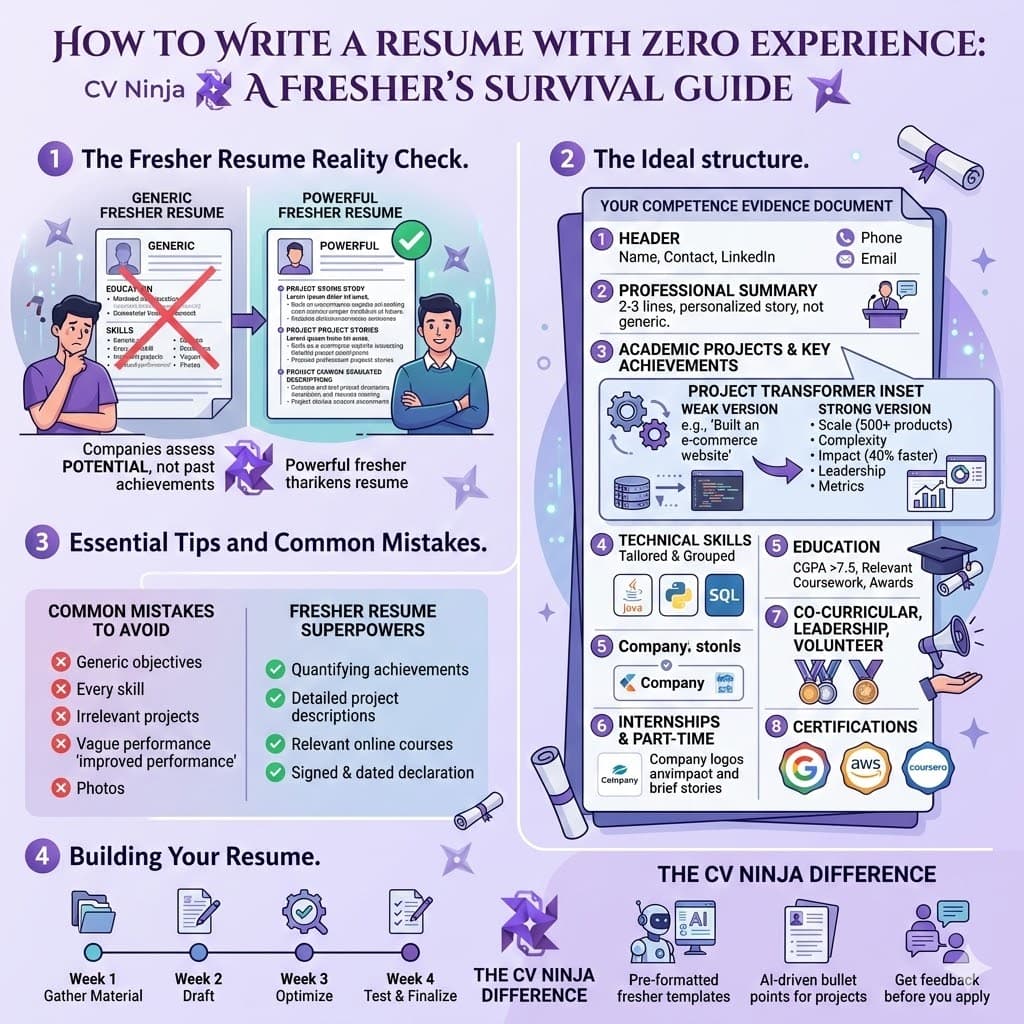
The Fresher Resume Structure: What Actually Works
Forget the traditional "Work Experience → Education" structure. For freshers, here's what works:
1. Header (Name, contact, location)
2. Professional Summary or Objective (2-3 lines)
3. Academic Projects or Key Achievements (your strongest work)
4. Technical Skills
5. Education
6. Internships/Part-time Experience (if any)
7. Co-curricular Activities, Leadership, Volunteer Work
8. Certifications (if any)
Notice what's missing? A "Work Experience" section. Because you don't have work experience. And that's okay. What you have instead is evidence of competence.
Section 1: The Header (Name, Contact, Location)
Keep it simple:
PRIYA SHARMA
Bangalore, India | +91 98765-43210 | priya.sharma@email.com | linkedin.com/in/priyasharma
That's it. Your phone number (in Indian format), email, and LinkedIn. You don't need your full address. You don't need your date of birth. You don't need a photo attached.
One thing to check: Make sure your email address is professional. If your current email is "priyadancer@gmail.com" or "sexy_priya@yahoo.com," create a new one. It takes 2 minutes. Use your first and last name or a variation.
Section 2: Professional Summary or Career Objective (Optional, But Effective)
This is where you tell a 2-3 line story that transforms you from "just another fresher" into "this person has direction."
What NOT to write:
OBJECTIVE
To secure a challenging role in a reputed organization where I can utilize
my skills and grow with the organization.
This is generic. Every fresher writes this. It tells the recruiter nothing specific.
What TO write (show specificity and enthusiasm):
Example 1 (For a software engineering role):
PROFESSIONAL SUMMARY
Recent Computer Science graduate with strong fundamentals in full-stack development.
Passionate about building scalable backend systems. Seeking a Software Engineer role
where I can contribute to production systems while continuously learning.
Example 2 (For a data analytics role):
PROFESSIONAL SUMMARY
Statistics graduate with hands-on experience in Python, SQL, and data visualization.
Interested in leveraging analytical skills to drive business insights in fast-paced
organizations. Eager to transition from academic projects to real-world data challenges.
Example 3 (For a product management internship):
PROFESSIONAL SUMMARY
Recent graduate with passion for understanding user problems and building solutions.
Experienced in conducting user research and iterating on prototypes. Seeking a
Product Associate role to apply product thinking to real-world challenges.
Notice the pattern: (1) Who you are, (2) What you're good at, (3) What you're looking for. Specific. Authentic. Not generic.
Section 3: Academic Projects or Key Achievements
This is your superpower as a fresher.
This section replaces the "Work Experience" section for freshers. Here's where you showcase that you've actually built things, solved real problems, or demonstrated competence.
Most freshers gloss over their college projects. "Semester Project: E-commerce Website, Java, 2025." Boring.
Instead, tell the story of what you built and what you learned.
The Academic Project Transformer: How to Turn a 2-Month College Project into a Resume Bullet
Rule: Quantify, Contextualize, Emphasize Impact
Weak version:
Built an e-commerce website using Java and MySQL
Strong version:
Designed and deployed full-stack e-commerce platform handling 500+ product listings,
user authentication, and payment integration. Implemented SQL database optimization
reducing page load time by 40%. Led code reviews for team of 3 developers.
See the difference? The second version includes:
- What you built (e-commerce platform)
- Scale (500+ products)
- Complexity (authentication, payments, database optimization)
- Impact (40% faster page load)
- Leadership (led code reviews)
Another example:
Weak:
Machine Learning project on house price prediction
Strong:
Trained and evaluated 5 ML models (Linear Regression, Random Forest, Gradient Boosting)
on Indian real estate dataset. Achieved 92% accuracy on test set using feature engineering
and hyperparameter tuning. Created data visualization dashboard in Python revealing price
trends across 5 major Indian cities.
This version includes:
- Models tested (5 approaches)
- Dataset context (Indian real estate, relevance)
- Results (92% accuracy)
- Technique (feature engineering, hyperparameter tuning)
- Application (visualization, actionable insights)
How Many Projects Should You Include?
For a 1-year-old fresher: 3-4 projects maximum For a final-year student: 2-3 projects maximum (focus on the strongest ones) Quality > Quantity: Better to have 2 projects with detailed, impressive descriptions than 6 mediocre ones.
Choose projects that:
- Are relevant to the role you're applying for
- Show different skills (e.g., one backend project, one data science, one full-stack)
- Have measurable outcomes or interesting technical challenges
- Involved collaboration (ideally)
The Capstone/Thesis Project
If you did a significant capstone project or engineering thesis, give it its own mention:
CAPSTONE PROJECT
Title: Sentiment Analysis of Hindi Tweets Using Deep Learning (2026)
- Collected and labeled 50K+ tweets in Hindi, a under-resourced language
- Built LSTM-based classifier achieving 87% F1 score on multi-class sentiment
- Published analysis of findings; paper submitted to NLP conference
- Technologies: Python, TensorFlow, NLP, Deep Learning
This signals serious academic work and potentially publications (even academic publications count as validation).
Section 4: Technical Skills (Tailor Per Job)
This is crucial for IT roles. For non-tech roles, modify to "Professional Skills."
Format: Group skills by category to make them scannable.
TECHNICAL SKILLS
Languages: Java, Python, JavaScript, SQL, HTML/CSS
Frameworks & Libraries: Spring Boot, React, TensorFlow, Pandas, NumPy
Databases: MySQL, PostgreSQL, MongoDB
Tools & Platforms: Git, Docker, AWS, Linux, Postman
Tailoring per job: This is KEY. If you're applying for a React.js position, make sure "React" is near the top. If you're applying for a data science role, lead with Python and data science libraries.
Common mistake: Listing every language you touched in the first semester.
Languages: Java, Python, C++, C, JavaScript, Ruby, Go, Rust, Swift, Kotlin, PHP, R
This makes you look like you know nothing deeply. Instead, list languages you're actually comfortable with. If you learned Ruby for one weekend project and haven't touched it since, leave it off.
Rule of thumb: Include skills you've used in projects. If it's not in your projects, don't list it. If it's listed but not in your projects, a recruiter might ask you about it in interviews, and you'll look silly.
Section 5: Education
Keep it focused and relevant.
EDUCATION

Bachelor of Technology in Computer Science
Indian Institute of Technology Delhi, New Delhi | Expected June 2026
CGPA: 8.3/10 | Relevant Coursework: Data Structures, Algorithms, Machine Learning, Databases, Web Development

Bachelor of Science in Statistics
Mumbai University, Mumbai | Graduation: April 2026
GPA: 8.5/10 | Merit Scholarship: Top 5% of batch
What to include:
- Degree name and major
- University name and location
- Expected graduation date (or graduation date if graduated)
- CGPA/GPA (only if 7.5 or above; if below, omit)
- Relevant coursework (3-4 key subjects related to the role)
- Merit scholarships or honors (only if significant)
What to omit:
- Full address of university
- Intermediate exam scores (12th grade marks)
- School name
- Irrelevant coursework (nobody cares about your sports elective)
CGPA below 7.5? Honestly, it's better to omit it than to include it. Your projects and internships matter more anyway.
Section 6: Internships and Part-Time Experience
If you did internships, this goes here. Even for freshers, internship experience is incredibly valuable.
SUMMER INTERNSHIP
Data Science Intern, ABC Analytics, Bangalore | May 2025 - July 2025
- Analyzed customer churn patterns using Python and SQL; created predictive model
- Built dashboard in Tableau visualizing key business metrics for C-suite
- Collaborated with Data Engineering team to optimize data pipeline

FREELANCE PROJECT
Content Writer & Researcher, IndieHackers, Remote | Jan 2025 - March 2025
- Wrote 12 technical blog articles on Python and Web Development
- Articles generated 10K+ monthly reads and featured on Hacker News
Notice the format: [Type of role], [Company], [Location] | [Dates]
For each, include 2-3 bullets with impact-driven language.
Section 7: Co-curricular Activities, Leadership, Volunteering
This is where you show you're not just an academic robot.
LEADERSHIP & ACTIVITIES

Student Tech Lead, Coding Club IIT Delhi | 2024-2025
- Led a club of 150+ members; organized 12 technical workshops and 2 hackathons
- Mentored 20 junior members; 3 went on to secure internships at major tech companies

Winner, Inter-College Hackathon | Tech Innovation Summit 2025
- Developed AI-powered mobile app for crop disease detection in 24 hours
- App selected as Most Impactful Solution by judges

Teaching Assistant, Data Structures & Algorithms Course | 2024-2025
- Conducted tutorials for 40 students; graded assignments and exams
- Created 10 educational videos on complex DSA concepts; 500K views on YouTube
Include these:
- Leadership roles in college organizations
- Hackathon wins or notable participations
- Teaching/mentoring roles
- Volunteer work (especially if it matches the company's values)
- Recognition or awards
Skip these:
- Being a member of something (if you did nothing significant)
- Irrelevant activities (unless they show a skill or trait valuable to the role)
- Vague descriptions ("active member of Rotary Club")
Section 8: Certifications and Continuous Learning
In 2026, freshers who've done online courses or certifications stand out.
CERTIFICATIONS & PROFESSIONAL DEVELOPMENT

Google Cloud Associate Cloud Engineer (In Progress, Expected March 2026)

Data Science Specialization, Coursera | Completed 2025
- 5-course specialization covering Python, statistics, machine learning, and data visualization

Full-Stack Web Development Bootcamp, Udemy | Completed 2024
- 120-hour bootcamp covering React, Node.js, MongoDB, and deployment

Programming Languages: A Complete Guide (MIT OpenCourseWare) | 2024
Include:
- Relevant online certifications (Google, AWS, Coursera)
- Bootcamp completions (if they're reputable)
- MOOCs and courses from known platforms
- Language certifications (TOEFL, IELTS, if applying internationally)
Skip:
- Free 1-hour "Introduction to X" courses
- Vague certificates with no recognized credential
- Paid certificates that are essentially participation trophies
The Fresher Resume Template: Putting It All Together
Here's a real, complete example:
ROHAN MEHTA
Delhi, India | +91 98765-43210 | rohan.mehta@email.com | linkedin.com/in/rohanmehta

PROFESSIONAL SUMMARY
Computer Science graduate with strong fundamentals in full-stack development and
cloud technologies. Demonstrated ability to build scalable systems and lead technical
initiatives. Seeking Software Engineer role to contribute to production systems
while mentoring junior developers.

ACADEMIC PROJECTS

Full-Stack Expense Tracker Application (2025)
- Designed and deployed full-stack web app using React, Node.js, and MongoDB
- Implemented JWT-based authentication and encrypted password storage
- Created REST API handling 500+ daily transactions; optimized database queries
- Deployed on AWS EC2 and implemented CI/CD pipeline using GitHub Actions
- Technologies: React, Node.js, MongoDB, AWS, Docker, GitHub Actions

Machine Learning Model: Student Performance Prediction (2024)
- Built ML pipeline predicting exam performance using student behavior data
- Tested 6 models (Linear Regression, Random Forest, XGBoost); achieved 89% accuracy
- Created data visualization in Python revealing learning patterns
- Technologies: Python, Scikit-learn, Pandas, Matplotlib, Jupyter Notebook

E-commerce Search Engine Optimization (2024)
- Optimized product search for 10K+ item catalog; improved query latency by 60%
- Implemented Elasticsearch for full-text search and filtering
- Technologies: Elasticsearch, Python, REST API

TECHNICAL SKILLS
Languages: Java, Python, JavaScript, SQL, HTML/CSS
Frontend: React, Vue.js, Bootstrap, CSS3
Backend: Node.js, Express, Spring Boot, RESTful APIs
Databases: MongoDB, MySQL, PostgreSQL
Cloud & Tools: AWS (EC2, S3), Docker, GitHub, Git, Linux, Postman

EDUCATION
Bachelor of Technology in Computer Science
Delhi Technological University, Delhi | Expected June 2026
CGPA: 8.4/10 | Relevant Coursework: Data Structures, Algorithms, Database Management, Web Development

INTERNSHIP EXPERIENCE
Software Engineering Intern, TechCorp India, Bangalore | May 2025 - July 2025
- Developed microservice for payment processing; handled 1000+ transactions daily
- Reduced API response time by 35% through database query optimization
- Participated in code reviews and contributed to team documentation

LEADERSHIP & ACTIVITIES
Technical Head, Coding Club DTU | 2024-2025
- Led club of 100+ members; organized 8 technical workshops and hosted annual hackathon
- Mentored 15 junior members; developed curriculum for DSA bootcamp

Winner, Local Hackathon | Code Innovation 2025
- Built AI chatbot for customer support in 24 hours
- App recognized as Most Scalable Solution

CERTIFICATIONS
AWS Certified Cloud Practitioner (In Progress, Expected May 2026)
Python for Data Science, Coursera | Completed 2025
Notice:
- 1 page, everything important included
- Strong professional summary setting direction
- 3 well-described projects (not 10 mediocre ones)
- Technical skills grouped by category
- Internship with impact metrics
- Leadership roles with numbers
- No fluff, no generic statements
Common Fresher Resume Mistakes (And How to Avoid Them)
Mistake 1: Using "Objective" instead of "Professional Summary" Generic objectives are dated. "To secure a role in a reputed organization" could be written by anyone. Instead, write a summary that shows direction and self-awareness.
Mistake 2: Listing skills you don't really have If you say "Java," prepare for a coding interview in Java. If you say "Leadership," be ready to back it up with examples.
Mistake 3: Including irrelevant projects Your semester project on "Creating a Login Page in HTML" is not impressive anymore. Include projects that are complex, relevant, or demonstrate initiative.
Mistake 4: Failing to quantify achievements "Improved performance" is vague. "Improved API response time by 35%" is concrete.
Mistake 5: Including your photo Unless applying to creative fields or the specific job asks for it, skip the photo. Let your resume speak for itself.
Mistake 6: Mentioning 2-3 different career objectives Your resume should tell one clear story: "I'm a backend engineer interested in systems design," not "I'm open to frontend, backend, DevOps, or data science roles."
Mistake 7: Too much formatting, fancy fonts, graphics Keep it simple. ATS systems struggle with fancy formatting, and recruiters prefer readable, professional resumes.
Mistake 8: Including marks for every semester Your overall CGPA is enough. Semester-wise breakdowns clutter the resume.
Building Your Fresher Resume: A Step-by-Step Action Plan
Week 1: Gather material
- List all projects you've done (college, personal, hackathons)
- List all internships or part-time work
- List all leadership roles, volunteer work, certifications
- Write 1-2 lines on each (impact you created, skills developed)
Week 2: Draft your resume
- Choose a simple template (Google Docs, Overleaf, or MS Word with no fancy formatting)
- Write your professional summary (2-3 lines, specific to roles you're targeting)
- Write project descriptions using the Academic Project Transformer approach
- Fill in other sections
Week 3: Optimize and tailor
- Tailor skills section per job description
- Reorder projects based on relevance to target role
- Check for spelling and grammar errors
- Ensure dates, names, university names are correct
Week 4: Test and finalize
- Save as PDF
- Copy-paste into plain text editor; does it look good?
- Share with 2-3 seniors or mentors; get feedback
- Make final adjustments
- You're done!
The Truth About Fresher Resumes
Here's what we've learned at CV Ninja working with 500K+ freshers:
Your fresher resume doesn't need to be perfect. It needs to be honest and interesting.
Recruiters hiring freshers don't expect you to have shipped a product to millions of users. They expect you to have learned something, taken initiative, and shown you're coachable.
Your resume's job is to get you the interview. The interview is where you show your personality, your curiosity, and your potential to grow.
So focus on:
- Clear communication (can they understand your projects easily?)
- Quantified impact (what's the measurable outcome?)
- Relevant skills (are you learning what the role requires?)
- One clear narrative (are you telling one story or 10 different stories?)
If you nail those four, your fresher resume will get you interviews.
Ready to build your first powerful resume? [INTERNAL: /fresher-templates - CV Ninja's dedicated fresher templates] are designed specifically for students and recent graduates. Our AI will help you transform your college projects and internships into compelling resume bullets. Plus, get feedback on your professional summary and skills section before you apply. Start building your resume today—free.
Continue Reading

Ready to Build Your Resume?
Create a professional, ATS-friendly resume in minutes with CV Ninja's AI-powered resume builder.
Get Started Free