 CV Ninja Team
Resume Keywords for 2026: The Industry-Wise Cheat Sheet Indian Job Seekers Need
Master the resume keywords that matter in 2026. Industry-specific ATS keyword lists, extraction techniques, and CV Ninja's AI-powered suggestions.
Resume Keywords for 2026: The Industry-Wise Cheat Sheet Indian Job Seekers Need
Your resume lands in an ATS (Applicant Tracking System) before a human ever sees it. That cold reality hits different when you realize your perfect resume might never make it past the software barrier—not because it's bad, but because it's missing the magic words. You could be the most qualified candidate for a Data Analyst role at a Bangalore fintech startup, yet if your resume says "analyzed data" while they're scanning for "data manipulation," "statistical analysis," and "SQL," you'll be filtered out faster than a spam email.
This isn't just paranoia. Studies show that 75% of resumes never reach a recruiter's desk because they fail the ATS keyword test. In India's competitive job market—where thousands apply for a single position on Naukri, LinkedIn, and company websites—keywords are the difference between being discovered and being deleted.
Why Keywords Are Your Resume's Secret Superpower
Think of your resume as a conversation with two audiences: a robot and a human. The robot (ATS) reads first. If your resume doesn't speak the robot's language, it never reaches the human who might actually love your background.
When a company posts a job on Naukri or their career portal, they don't just write a description. They seed it with keywords—the specific terms, tools, methodologies, and experiences they're hunting for. An example:
What the job description says: "We need someone proficient in Python, skilled at building machine learning models, with experience in cloud platforms like AWS or GCP."
What the ATS is really scanning for: Python, machine learning, ML, TensorFlow, Keras, AWS, GCP, scikit-learn, data pipeline, model training, etc.
If your resume says "I have Python experience and built ML models," you'd get points. But if it says "Python, TensorFlow, AWS, scikit-learn, model deployment, cloud infrastructure," you'd get far more matches because you're speaking the language the algorithm understands.
Here's the hard truth: Your resume can be perfect for human readers but invisible to the algorithm. The winning strategy is to optimize for both—clarity for humans, keywords for machines.
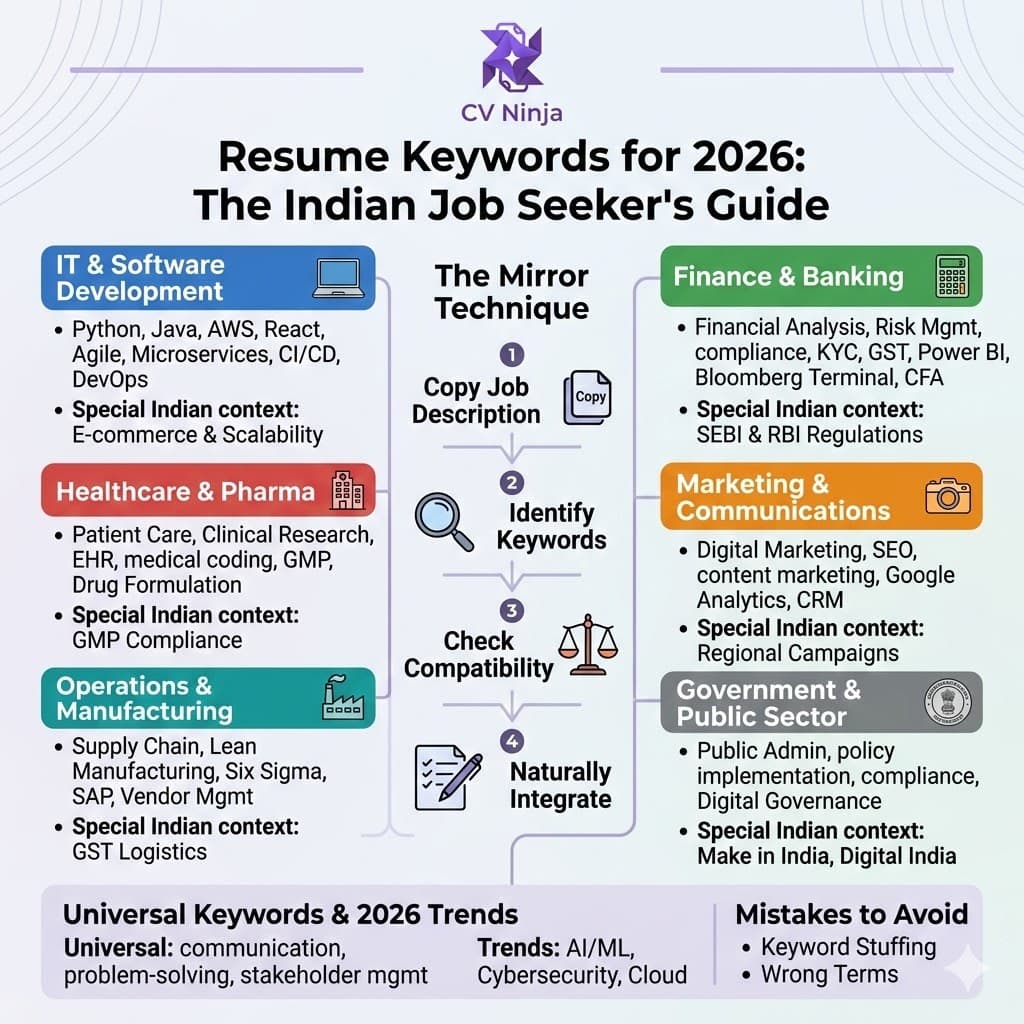
The Mirror Technique: How to Extract Keywords Like a Pro
Before we dive into industry-specific keyword lists, you need a system to extract keywords from any job description. I call this the Mirror Technique, and it works across all industries.
Here's how it works:
- Copy the job description into a document (copy from Naukri, LinkedIn, or company websites)
- Highlight every skill, tool, and methodology mentioned (Python, Tableau, Agile, Six Sigma, SAP, etc.)
- Note the exact phrases they use—not paraphrases, but the actual words
- Cross-reference with your experience—where do you have these skills?
- Integrate 8-12 of the most relevant keywords into your resume naturally
Let's see this in action. Imagine this is a real Naukri job posting for an IT Manager role:
"Looking for an IT Manager with 5+ years of experience managing IT teams in the financial services sector. Must have strong knowledge of infrastructure management, system security, compliance (ISO 27001, SOC 2), and cloud migration. Experience with AWS, Azure, or Google Cloud is essential. Familiarity with agile methodologies and change management is preferred."
Extracted keywords: IT Manager, IT team management, infrastructure management, system security, compliance, ISO 27001, SOC 2, cloud migration, AWS, Azure, Google Cloud, agile, change management
Mirror technique in action: If you've managed IT teams, your resume should now include those exact terms: "Managed IT team of 8 professionals," "Led cloud migration to AWS," "Ensured system security and ISO 27001 compliance," etc.
This isn't keyword stuffing. It's honest translation of your experience into the language employers use.
Industry-Specific Keyword Cheat Sheets for India
IT & Software Development
Core technical keywords: Python, Java, JavaScript, C++, React, Angular, Node.js, SQL, NoSQL, MongoDB, RESTful APIs, microservices, Docker, Kubernetes, CI/CD, Git, Jenkins, Linux, Windows Server
Development methodologies: Agile, Scrum, Kanban, Waterfall, Sprints, user stories, debugging, code review, test-driven development
Cloud & infrastructure: AWS, Azure, GCP, EC2, S3, Lambda, RDS, cloud architecture, infrastructure as code, Terraform, deployment automation
For Bangalore tech workers: If you're applying at Flipkart, Amazon India, or TCS—add "e-commerce," "high scalability," "distributed systems," "payment gateways"
Finance & Banking
Core financial keywords: Financial analysis, investment banking, risk management, portfolio management, compliance, KYC, AML, IFRS, GST, income tax, audit, financial modeling, Excel, Power BI, Bloomberg Terminal
Banking-specific: Retail banking, corporate banking, payment systems, RTGS, NEFT, digital banking, fintech, blockchain (if relevant)
Certifications to mention: CFA, CA, FRM, CAIIB, CPA equivalents
For Indian finance roles: Emphasize "SEBI compliance," "RBI regulations," "FEMA compliance," "Indian taxation," especially if applying to HDFC, ICICI, Axis Bank roles
Healthcare & Pharma
Clinical keywords: Patient care, diagnosis, treatment planning, clinical research, EHR systems, medical coding, HIPAA compliance, quality assurance, pharmacology
For Indian pharma: GMP (Good Manufacturing Practice), drug formulation, regulatory compliance, clinical trials, bioavailability studies, Six Sigma
Tech-savvy healthcare: Telemedicine, EMR systems, healthcare IT, medical device management
Marketing & Communications
Core marketing keywords: Digital marketing, SEO, SEM, content marketing, social media management, email marketing, brand management, market research, customer acquisition, conversion optimization, Google Analytics, A/B testing, copywriting
For India's marketing scene: "Indian market research," "vernacular content," "regional campaigns," "festive marketing," "mobile-first strategy"
Agency and brand keywords: Campaign management, creative direction, stakeholder communication, CRM, marketing automation, HubSpot, Salesforce
Manufacturing & Operations
Operations keywords: Supply chain management, inventory management, lean manufacturing, Six Sigma, kaizen, production planning, vendor management, quality control, procurement, SAP, ERP systems
For Indian manufacturing: "Factory operations," "vendor management in India," "GST logistics," "export compliance," "Indian manufacturing standards"
Specialized: Just-in-time (JIT), MRP systems, production optimization, cost reduction
Government & Public Sector
Government job keywords: Policy implementation, stakeholder management, public administration, regulatory compliance, government schemes, digital governance, administrative procedures, documentation, grievance redressal, citizen services
For government posts: Mention relevant government initiatives—Digital India, Skill India, Make in India, Swachh Bharat (if relevant to role)
Competitive exam keywords: Project management, process improvement, data management, official correspondence, audit, compliance
How CV Ninja's AI Auto-Suggests Relevant Keywords
Manually finding and integrating keywords takes time. This is where [INTERNAL: /ai-resume-builder - CV Ninja's AI resume builder] changes the game.
When you input a job description into CV Ninja's keyword optimization feature, the AI:
- Scans the job posting for industry-standard keywords
- Compares your current resume against those keywords
- Identifies gaps—keywords you're missing that match your actual experience
- Suggests natural integration points—where to add keywords without making your resume sound robotic
- Checks for ATS compatibility—ensures formatting won't break the keyword matching
The result? Your resume gets optimized for both ATS algorithms and human readers. You're not guessing anymore.
Practical Exercise: Optimize a Real Naukri Listing
Let's walk through an actual optimization. Here's a sanitized Naukri job posting:
Position: Senior Business Analyst, Delhi-based fintech startup
Job Description excerpt: "We're looking for a Senior Business Analyst with 4+ years of experience in financial services. Must be proficient in data analysis, SQL, and Tableau. Experience with agile processes and cross-functional collaboration is essential. Should be comfortable with technical documentation and have a strong understanding of payment systems, API integrations, and fintech workflows."
Step 1: Extract keywords
- Senior Business Analyst
- Business analysis
- Financial services
- Data analysis
- SQL
- Tableau
- Agile
- Cross-functional collaboration
- Technical documentation
- Payment systems
- API integrations
- Fintech workflows
Step 2: Assess your fit Let's say you're a Business Analyst with 5 years in banking. You have:
- ✓ Business analysis experience (4+ years with a bank)
- ✓ SQL knowledge (used in daily work)
- ✗ Tableau (you used Excel and Power BI instead)
- ✓ Agile (worked in Agile sprints)
- ✓ Cross-functional experience (worked with tech, ops, compliance)
- ✓ Technical documentation (wrote requirements docs)
- ✗ Payment systems (not direct experience, but you've worked on banking integrations)
- ✗ API integrations (not explicitly in your background)
Step 3: Reframe your experience Original bullet point: "Analyzed banking processes and created dashboards for management reporting"
Optimized bullet point: "Conducted business analysis for payment processing systems; created data analysis reports using SQL and technical documentation to support cross-functional teams through agile sprints; collaborated on banking integrations that processed 50,000+ daily transactions"
Notice how we:
- Added "SQL" (something you do but hadn't explicitly mentioned)
- Added "payment processing" (reframing your banking work)
- Added "agile" (something you did)
- Kept language honest but keyword-rich
- Showed impact (50,000+ daily transactions)
Step 4: Check ATS score With CV Ninja's [INTERNAL: /ats-score-checker - ATS Score Checker], you'd see your resume went from 62% match to 81% match—a massive difference.
The Keywords You Should Never Ignore
Universal keywords that show up across almost all job postings in India:
- Communication skills
- Problem-solving
- Team collaboration / Teamwork
- Project management
- Time management
- Detail-oriented
- Results-driven
- Stakeholder management
- Continuous improvement
These aren't flashy, but they appear in nearly every job description. Make sure they appear somewhere in your resume.
2026 trending keywords (emerging skills companies are actively hiring for):
- Artificial Intelligence / Machine Learning
- Data Analytics
- Cybersecurity
- Cloud computing
- Automation
- Sustainability / ESG
- Digital transformation
- Remote work / Hybrid work
- Soft skills frameworks (emotional intelligence, adaptability)
If you have any experience in these areas, make them prominent.
The Mistakes People Make With Keywords
Mistake 1: Keyword stuffing Loading your resume with keywords that aren't relevant to your background. "I'm experienced with Python, Java, Go, Ruby, Rust, C#..." when you've only used Python. This screams dishonesty and actually hurts your chances with recruiters who check references.
Mistake 2: Using wrong terminology India's tech industry uses specific terms. A recruiter looking for "machine learning" won't find a resume that only says "AI." A search for "ERP" won't match "enterprise resource planning" on some systems. Use the exact terms from the industry.
Mistake 3: Ignoring soft skill keywords You're so focused on technical keywords that you forget about "communication," "leadership," "stakeholder management." These matter for most roles.
Mistake 4: Not updating keywords by role Sending the same resume to 10 different jobs. Keywords for a Data Analyst role differ from Data Engineer differ from Data Scientist. Each application should have a slightly adjusted keyword focus.
Your Action Plan: Start Today
- Find 3 jobs you actually want (on Naukri, LinkedIn, or company websites)
- Use the mirror technique to extract 15-20 keywords from each
- Create a keyword list for your target role
- Audit your current resume against that list—what's missing?
- Integrate 8-12 keywords naturally into your resume
- Use CV Ninja's AI to auto-generate keyword suggestions and check your ATS score
The difference between a resume that gets filtered out and one that makes it to a recruiter's desk often comes down to 10-15 words. Master the keywords, and you've solved half the battle.
Ready to optimize your resume for both ATS algorithms and human readers? [INTERNAL: /ai-resume-builder - Try CV Ninja's AI Resume Builder today]—get instant keyword suggestions tailored to your target role, plus real-time ATS score checking. From Free to ₹99 and ₹299 one time, we've got a plan for every job seeker. Your dream role is waiting. Make sure your resume gets there.
Continue Reading

Ready to Build Your Resume?
Create a professional, ATS-friendly resume in minutes with CV Ninja's AI-powered resume builder.
Get Started Free