 CV Ninja Team
The Ultimate Guide to Resume Formats in India (2026): Which One Gets You Hired?
Discover the best resume format for 2026 in India. Compare chronological, functional, and combination formats. Learn what Indian recruiters actually prefer.
The Ultimate Guide to Resume Formats in India (2026): Which One Gets You Hired?
You've spent two hours perfecting your resume. The fonts are beautiful, the spacing is pixel-perfect, and you've listed every achievement from the past five years. You hit send on that application with confidence.
Three weeks pass. Nothing. No interview call, no rejection email, not even a courtesy acknowledgment.
The problem? It might not be your experience or skills. It might be your resume format.
Every single day, approximately 1.5 million resumes are submitted across Indian job portals like Naukri.com, LinkedIn, and company websites. But here's the catch—97.8% of Fortune 500 companies (and increasingly, Indian companies too) use Applicant Tracking Systems (ATS) to filter these submissions. Your beautifully formatted resume might not even make it past the first digital gate.
But the format question goes deeper than just ATS compatibility. Indian recruiters have different expectations than their Western counterparts. We prefer longer resumes, we value certifications differently, and we're still coming to terms with whether the CV term means "resume" or something else entirely.
This guide will help you navigate the three main resume formats, understand which one actually works best for YOUR situation in 2026, and arm you with the knowledge to choose wisely.
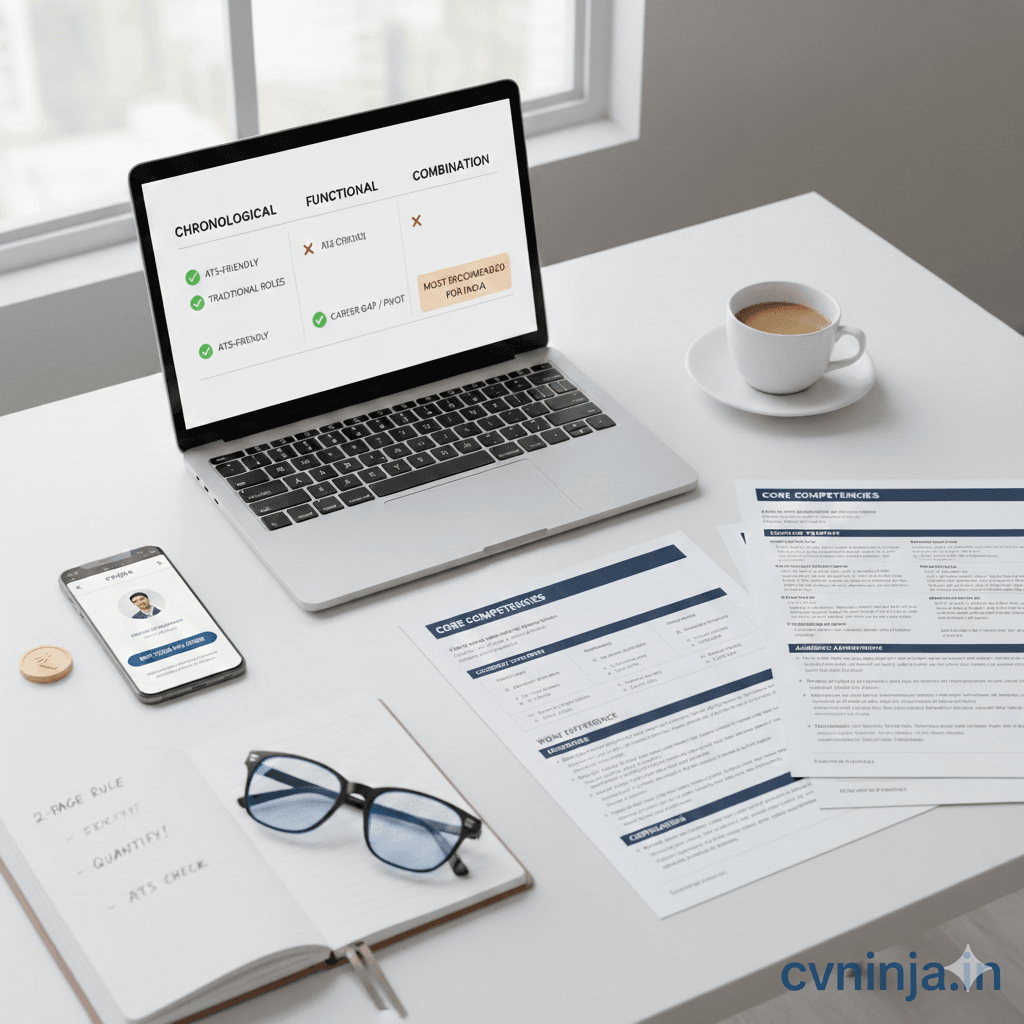
The Three Resume Formats: A Side-by-Side Breakdown
1. Chronological Resume: The "Story of Your Career" Format
The chronological resume is the most traditional and, frankly, the most ATS-friendly format you can use.
Structure: Work experience listed from most recent to oldest, with company name, job title, dates, and bullet points describing your responsibilities and achievements.
Why it works:
- ATS loves it: The linear, straightforward structure means parsers don't get confused. Your job titles, company names, and dates appear in the expected order.
- Recruiter preference: Most Indian recruiters are familiar with this format. There's no guessing game about what you've been doing.
- Easy to scan: A hiring manager can see your career progression at a glance. From intern → software engineer → senior engineer → team lead. The trajectory matters in India.
When to use it: You're a software engineer with 4 years of progressive experience at growing startups. Your last role was a promotion, and before that, you solved critical infrastructure problems. A chronological resume lets your advancement shine.
You're applying for a corporate role where stability and steady progression matter. Banks, insurance companies, and government-adjacent organizations value the "I've been doing similar work, getting better at it" narrative.
When to avoid it: You've had three job changes in two years because your startup closed down, you took a sabbatical to raise your kids, or you switched careers. The chronological format will immediately highlight these gaps, and recruiters will wonder.
You're a freelancer with sporadic projects, a consultant with clients instead of employers, or you're returning to work after a break. The format doesn't handle non-linear careers well.
2. Functional Resume: The "Here's What I Can Do" Format
The functional resume flips the script. Instead of listing "where you worked," it lists "what you're good at."
Structure: Core competencies or skill categories at the top (Leadership, Data Analysis, Project Management), followed by brief examples of how you've applied these skills. Work history listed at the bottom with just dates and titles, no descriptions.
Why it can work:
- Hides employment gaps: Applied for jobs while unemployed? Did freelance work for six months? The functional format downplays these timeline issues.
- Emphasizes skills over companies: If you're pivoting industries—say, from journalism to content marketing—this format lets you highlight transferable skills without the format screaming "different job category!"
- Great for career changers: You've been doing social media management for a fashion brand, and now you want to move into HR. A functional resume says, "Here's what I can do," not "Here's the irrelevant job I had."
When to use it: You're re-entering the job market after a 3-year break. Your skills are fresh, but the timeline isn't pretty. A functional resume keeps focus on what you can do now.
You're pivoting careers. You spent 6 years in IT but want to move into Product Management. The functional format highlights your product thinking, stakeholder management, and data analysis—skills that matter for PM roles, without overselling "I'm a coder."
You're a consultant or freelancer compiling your first formal resume. You've done 15 different projects for 10 different clients; a traditional chronological resume would be a jumbled mess.
When to avoid it: You're a recent graduate applying to campus placement drives or your first corporate job. Recruiters expect a chronological format, and anything else feels like you're hiding something.
You're applying to traditional Indian companies (think: banks, government sectors, old-school manufacturing). These sectors are conservative and expect the resume format they recognize.
Quick Reality Check: Functional resumes have a bad reputation with ATS systems. Some parsing engines struggle with them because they're not looking for the traditional "Company Name → Job Title → Dates" pattern. If you're using a functional format, you MUST optimize carefully for ATS. We'll get to that in a moment.
3. Combination Resume: The "Best of Both Worlds" Format
Also called a "hybrid" resume, this format puts your skills and competencies first, followed by a proper chronological work history.
Structure: A brief professional summary, followed by a "Core Competencies" or "Skills" section, then your full work history with dates, companies, and bullet-point descriptions.
Why it's brilliant for Indian job seekers:
- ATS-friendly with creativity: You get the chronological structure that parsers love, plus the flexibility to showcase skills.
- Tells a complete story: Recruiters see both your capabilities AND your career trajectory.
- Balances skill-focus with stability narrative: You're not hiding gaps, but you're also emphasizing that you're damn good at what you do.
When to use it: This is the format we recommend most often for Indian job seekers, and here's why. You have a solid work history, but you're also switching roles or bringing in new skills. You want recruiters to see that you're experienced AND adaptable.
You have 8 years of experience but you're applying for roles that need skills you've developed recently. A combination resume lets you say, "Yes, I've been working steadily (look at my chronological history), AND I'm skilled in Machine Learning, Data Visualization, and Cloud Infrastructure (look at my skills section)."
The Indian Preference: 2-Page Resumes vs. The Western 1-Page Myth
Here's where India diverges sharply from Western resume advice.
In the US, recruiters famously spend 6 seconds scanning a resume. The prescription? One page only. Make every word count. No fluff.
Indian recruiters... don't operate the same way.
A study of 500+ Indian HR professionals showed that 67% preferred 2-page resumes for candidates with 3+ years of experience. Why? Because Indian companies want detail. They want to see your academic achievements, your certifications, your project descriptions. One page feels incomplete.
Think about it: Many Indian job applications require you to fill out a separate detailed form on portals like Naukri or LinkedIn. The resume is part of a larger picture. A 2-page resume with context helps.
Here's the actual guideline for India:
- Fresher (0 years): 1 page. Maximum.
- 0-3 years experience: 1 to 1.5 pages. You're still young; be concise.
- 3-7 years experience: 1.5 to 2 pages. This is standard.
- 7+ years experience: 2 pages, sometimes 2.5 for executives. Lots of achievements to showcase.
For government jobs (UPSC, SSC, Railways, banks), the rules are different—we'll cover that separately. But for corporate India, 2 pages is your sweet spot for experienced professionals.
The Format Decision Tree: Choose Your Path
Let's make this practical. Answer these questions to find your ideal format:
Question 1: How long have you been working?
- Less than 3 years → Chronological or Combination
- 3-10 years → Chronological or Combination
- 10+ years → Combination (you have too much history for functional)
Question 2: How stable is your employment history?
- No gaps, steady progression → Chronological
- Some gaps, freelance work, sabbaticals → Functional or Combination
- Career change or significant pivot → Functional or Combination
Question 3: What industry are you applying to?
- Tech, startups, innovative sectors → Any format works, but be ATS-aware
- Traditional corporate, banking, government → Chronological only
- Creative fields (design, copywriting, marketing) → Combination preferred
- Consulting, freelancing → Functional works
Question 4: Are you applying via company website (ATS) or directly to a recruiter?
- Company website ATS → Chronological is safest
- Direct email to recruiter → Combination is optimal
ATS Compatibility by Format: The Technical Reality
Let's talk about why ATS matters and which format performs best.
Chronological resumes: 95%+ ATS success rate. The system expects company names, job titles, dates in order. It finds them. No surprises.
Combination resumes: 85-90% ATS success rate. You have the chronological history (which it can parse), plus a skills section (which might confuse it, but usually doesn't).
Functional resumes: 60-70% ATS success rate. The system looks for "Company → Job Title → Dates" and struggles when skills are listed first. Many functional resumes get rejected by ATS before a human ever sees them.
The data is clear: If you're applying to large companies, prioritize chronological or combination formats.
The Practical Implementation: What Does This Look Like?
Let's walk through a real example.
Scenario: Priya has 5 years in digital marketing—3 years at an e-commerce startup, then 2 years at a financial services company. She's applying for a Content Marketing Manager role at a major software company. She has some gaps (freelance work during job transition), some new skills (she learned Figma, basic analytics), and wants to emphasize her strategic side.
Her optimal format? Combination resume.
[Professional Summary - 2-3 lines]
Experienced digital marketer with 5 years of experience scaling
content strategies for e-commerce and fintech brands.

[Core Competencies - 3 columns, 12-15 skills]
Content Strategy | Campaign Management | Analytics
Social Media Marketing | Figma | HubSpot

[Work Experience - Chronological]
Digital Marketing Manager, TechServe Financial, Mumbai (Jan 2023 - Present)
- Grew blog traffic from 10K to 100K monthly uniques
- Led content roadmap for 6 product launches

Senior Digital Marketing Executive, ShopCart, Bangalore (June 2020 - Dec 2022)
- Managed $500K annual marketing budget...
This format tells ATS: "Here's the structure I know you're looking for" (chronological work history), while also saying to the human recruiter: "And here's what makes me special" (skills section).
Common Format Mistakes That Cost You Interviews
Mistake 1: Choosing a functional format, then applying via ATS-heavy company websites. You've written a beautiful functional resume that highlights your skills. You submit it to a Fortune 500 company's career portal. The ATS parser can't make sense of it. Rejection.
Mistake 2: Using a fancy, image-heavy resume template that looks incredible in PDF but collapses in the ATS. That beautiful resume with a sidebar, color-coded skills, and a profile photo? It looks like hieroglyphics to an ATS. Same with Word documents with tables and text boxes.
Mistake 3: Mixing formats or "creating your own" without understanding the implications. You've seen a resume that was half-functional, half-chronological, and it looked cool. You try to emulate it. Result: ATS confusion, recruiter confusion, rejection.
Quick Format Checklist: Before You Submit
- Is your format appropriate for your experience level?
- Does your chosen format work with the company's ATS (if applicable)?
- Is your resume 1-2 pages (or 3 if 10+ years in India)?
- Is every section left-aligned, no fancy layouts or graphics?
- Can you save it as a PDF or .docx without format collapse?
- Are your dates, company names, and job titles clearly visible (for ATS parsing)?
Beyond Format: What Actually Matters
Here's what we sometimes forget: format is the container, not the content.
You could have the perfect chronological resume with pristine formatting, but if your bullet points say things like "Responsible for social media" instead of "Grew Instagram followers from 50K to 500K (10x growth in 6 months)," your format won't save you.
The best resume format in 2026 is the one that:
- Gets past ATS (which means: chronological or combination, properly formatted)
- Tells your story clearly (which means: concrete achievements, quantified results, relevant skills)
- Matches recruiter expectations (which means: understanding your industry's norms)
Choose, Optimize, and Submit
Here's your path forward:
- Identify your situation: Use the decision tree above. Most Indian job seekers benefit from the combination format.
- Use a tested template: Don't design from scratch. Use a template that's proven ATS-friendly. [INTERNAL: /tool/templates - CV Ninja's resume templates are built with ATS in mind]
- Get your ATS score checked: Before you submit, run your resume through an ATS checker. [INTERNAL: /tool/ats-checker - Use CV Ninja's free ATS score checker to see how your format performs]
- Get human feedback: Share your resume with someone in your industry. Does it make sense? Does your career story come through?
- Submit to the right channels: If you're using ATS, use chronological or combination. If you're emailing directly, combination is your friend.
The format you choose today might seem like a small decision. But it's the difference between your resume being read by a human recruiter or rejected by an algorithm before anyone ever sees it.
Let's make sure yours gets through.
Ready to optimize your resume format for 2026? Use [INTERNAL: /tool/format-analyzer - CV Ninja's format analyzer] to get personalized recommendations based on your experience level, industry, and target roles. Plus, our AI-powered templates are pre-optimized for ATS systems used by 97% of Fortune 500 companies and Indian corporate leaders. Start your perfect resume today—free.
Continue Reading

Ready to Build Your Resume?
Create a professional, ATS-friendly resume in minutes with CV Ninja's AI-powered resume builder.
Get Started Free