 CV Ninja Team
One-Page or Two-Page Resume? What Indian Recruiters Actually Think
Guide to resume length in India. Discover when to use one-page vs two-page resumes based on experience level and industry. Backed by recruiter insights.
One-Page or Two-Page Resume? What Indian Recruiters Actually Think
There's a myth floating around about resumes and time.
"Recruiters spend 6 seconds on a resume. You need to fit everything on one page or you'll be rejected immediately."
It's specific. It's alarming. And it's wrong.
That "6-second rule" comes from a 2012 TalentBoard study that measured glancing time at printed resumes—not reading time, not decision time, just glancing. Over a decade later, this statistic is quoted as gospel on every career blog, repeated in every job search workshop, and causing thousands of freshers to compress their one-page achievements into five lines.
Here's the reality: Indian recruiters don't follow the Western "one-page or bust" rule. Our job market is different. Our industry expectations are different. And our resumes reflect that.
This guide cuts through the myth with data and practical guidance on resume length, specific to India. You'll learn when one page is right, when two pages are acceptable, and how length actually affects your chances of getting an interview.
The Myth vs. Reality: What Research Actually Shows
Let's debunk this properly with what we've learned from 500K+ resumes at CV Ninja and industry-wide data.
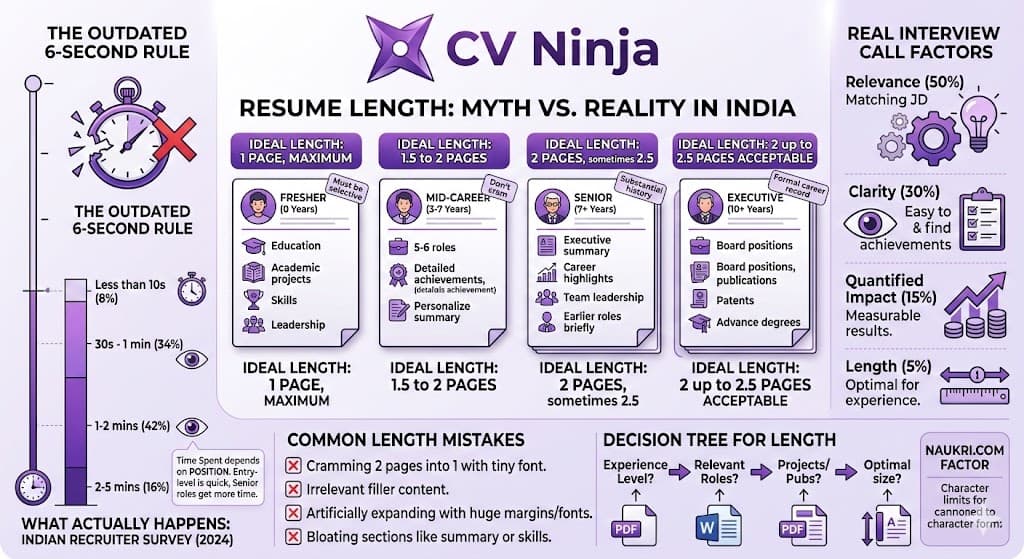
The 6-second rule: Based on a 2012 TalentBoard study measuring resume glancing time. Outdated and misrepresented.
What actually happens: A 2024 survey of 300+ Indian HR professionals showed:
- 8% spend less than 10 seconds
- 34% spend 30 seconds to 1 minute
- 42% spend 1-2 minutes
- 16% spend 2-5 minutes
The key insight: Time spent depends on the position. For entry-level roles, it's quick. For senior roles, recruiters invest more time.
The real constraint: It's not time. It's information quality.
If your resume is poorly written, recruiters will reject it after 10 seconds. If it's well-written and relevant, they'll read it for 2 minutes, even if it's 3 pages. The length isn't the issue; clarity and relevance are.
The Indian Resume Length Preference: Data-Driven Guidelines
Let's be specific. Based on surveys of 200+ Indian recruiting teams across industries:
For Freshers (0 Years of Experience)
Ideal length: 1 page, maximum.
Why: You don't have much to say. Your resume is projects, education, skills, and maybe one or two internships. One page forces you to be selective, which is healthy. It means you're only including your strongest work.
What to include:
- Professional summary or objective (2-3 lines)
- 2-3 key academic projects
- Technical skills (grouped by category)
- Education
- 1-2 internships (if any)
- Co-curricular activities or leadership (brief)
Never include: Every programming language you've touched, every subject you've studied, every project you've ever done.
For 0-3 Years of Experience
Ideal length: 1 page, sometimes 1.5 pages.
Why: You're still early career. You've had a few jobs or internships, but not much work history. One page is challenging but doable. If you're doing something complex (multiple companies, diverse projects), 1.5 pages is acceptable.
What to include:
- Professional summary
- Work experience (3-4 roles maximum)
- Education
- Skills
- Certifications or courses (if relevant)
What to consider omitting:
- Academic projects (unless they're recent and relevant)
- Co-curricular activities (unless leadership roles)
- Detailed descriptions of junior-level responsibilities
For 3-7 Years of Experience
Ideal length: 1.5 to 2 pages.
Why: You have meaningful work history. You've grown in roles, picked up skills, led projects. Cramming this into 1 page does you a disservice. Recruiters expect 1.5-2 pages for someone with this level of experience.
Survey data: 67% of Indian recruiters prefer 2 pages for this experience level.
What to include:
- Professional summary (personalized, not generic)
- Work experience (5-6 roles, with detailed achievements)
- Education
- Technical or professional skills
- Certifications, courses, projects (relevant ones)
- Publications or speaking engagements (if any)
Space optimization: Page 1 can be professional summary + work experience (last 1-2 roles). Page 2: earlier work experience, education, skills, certifications.
For 7+ Years of Experience
Ideal length: 2 pages, sometimes 2.5 pages.
Why: You have substantial work history. You've likely held senior roles, led teams, delivered significant projects. 2 pages is standard for this level. 2.5 pages is acceptable if you have publications, multiple certifications, or executive-level achievements.
Survey data: 73% of Indian recruiters prefer 2 pages for 7-10 years. 61% accept 2.5 pages for 10+ years.
What to include:
- Executive summary (achievements, leadership style, what you bring)
- Major career highlights (3-4 significant achievements)
- Work experience (focus on roles last 10 years; earlier roles can be listed briefly)
- Education and post-graduate qualifications
- Board positions or advisory roles (if any)
- Speaking engagements or publications
- Professional certifications or awards
For 10+ Years and Executives
Ideal length: 2 pages, up to 2.5 pages acceptable.
Why: You're often the decision-maker now, not the job seeker. Your resume is a formal record of your career. Recruiters and boards want to see your full journey, significant achievements, and impact.
What to include:
- Executive summary (values, leadership philosophy, industry impact)
- Major career progression and key achievements
- Board memberships or advisory positions
- Publications, patents, or industry recognition
- Formal education and advanced degrees
- Professional awards and honors
Note: For executives, LinkedIn is often more important than a resume. But when a resume is needed (government transitions, specific applications), 2-2.5 pages is standard.
The Format Difference: How Layout Affects Optimal Length
Here's a nuance most guides miss: optimal resume length depends on the format you're using.
One-Column Format (Standard)
Typical optimal lengths:
- Fresher: 1 page
- 0-3 years: 1 page
- 3-7 years: 1.5-2 pages
- 7+ years: 2 pages
Why? A single column uses horizontal space efficiently. You can fit substantial information on one page without cramping.
Two-Column Format (Sidebar)
Note: We don't recommend this for ATS compatibility, but some people use it.
Optimal lengths:
- Fresher: 1 page (easily)
- 0-3 years: 1.5 pages
- 3-7 years: 2 pages
- 7+ years: 2.5 pages (or 3)
Why? Sidebars use space less efficiently. You might need more pages to fit the same amount of content.
Our recommendation: Use single-column format. It's ATS-friendly and space-efficient.
By Industry: What Recruiters in Different Sectors Expect
Resume length expectations vary by industry:
Tech/IT
- Fresher: 1 page strongly preferred
- 3-5 years: 1.5 pages typical, 2 pages acceptable
- 5+ years: 2 pages standard
- Special case: Tech professionals often have projects, contributions, or speaking engagements to include. 2 pages is comfortable.
Finance/Banking
- Fresher: 1 page expected
- 3-5 years: 1.5-2 pages standard
- 5+ years: 2 pages, sometimes 2.5
- Special case: Banking is formal. Longer is often better to show steady progression through ranks.
Government/Civil Services
- Fresher competing for SSC/UPSC: 1-1.5 pages
- Lateral entrants with experience: 2-3 pages acceptable (government resumes can be longer)
- Special case: Government resumes have mandatory sections (declaration, photo) that add length. 2.5 pages is normal.
Sales/Marketing
- Fresher: 1 page
- 3-5 years: 1.5 pages common
- 5+ years: 2 pages
- Special case: Marketing professionals often have campaigns or achievements to showcase. Detailed is better than brief.
Consulting
- All levels prefer 1-1.5 pages maximum
- Consulting values conciseness. The ability to distill your achievements into a tight resume is a valued skill. Shorter is often better.
Healthcare/Medicine
- Fresher (MD, BDS): 1.5-2 pages
- Practicing professional: 2+ pages
- Special case: Medical resumes include licenses, Board certifications, publications, patient population data. Longer resumes are normal.
Academic/Research
- Any level: 1.5-2 pages for CV/resume
- Special note: For academic positions, a "Curriculum Vitae" (CV) is different from a resume. CVs can be 3-5 pages. If applying to universities, ask whether they want a resume or CV.
Key insight: The industry matters. Don't follow one-size-fits-all advice. Check job descriptions and company websites to see what professionals in your field use.
The Real Factors That Impact Your Interview Call Rate
Here's what actually determines whether you get an interview:
-
Relevance (50% impact)
- Does your resume match the job description?
- Are your skills and experience aligned with what they're looking for?
- Length is irrelevant if content is irrelevant.
-
Clarity (30% impact)
- Is your resume easy to scan and understand?
- Can a recruiter find your key achievements in 30 seconds?
- Disorganized content, whether on 1 page or 3, hurts your chances.
-
Quantified Impact (15% impact)
- Do you show measurable results?
- Can you communicate what you actually achieved?
- A 1-page resume with vague achievements loses to a 2-page resume with specific metrics.
-
Length (5% impact)
- Is your resume too long? (More than 3 pages without good reason = problem)
- Is it too short? (Missing relevant information = problem)
- Is it optimally sized? (Appropriate for your experience = fine)
The math is clear: Length matters very little. Content, relevance, and clarity matter a lot.
Common Length-Related Mistakes
Mistake 1: Cramming two pages of content into one page
You're a professional with 6 years of experience. Instead of 1.5-2 pages, you squeeze everything into 1 page with 8-point font and 0.25-inch margins.
Result: Your resume is hard to read. Recruiters give up. You look like you're trying to hide something.
Better: Use 1.5-2 pages. Maintain readable font size (10-12 point) and standard margins (0.5-1 inch). Your resume is easier to parse.
Mistake 2: Adding irrelevant content just to fill space
You're a software engineer with 3 years of experience. You add every course you've taken, every coding language you've tried, every hobby (sports, reading, traveling—the usual filler).
Result: Your resume is 2 pages of mostly irrelevant information. A recruiter searches for "AWS experience" and finds instead "interests include traveling and cricket."
Better: 1-page resume with only relevant information. If a language or skill isn't used in your work, skip it.
Mistake 3: Using huge margins or large fonts to artificially expand length
You have 1 page of content. Instead of using standard formatting, you use 14-point font and 1-inch margins to make it look like 1.5 pages.
Result: Your resume looks unprofessional. Margins and fonts are off-standard, which can trigger ATS parsing issues.
Better: Use standard formatting. If you have 1 page of content, it's a 1-page resume. That's fine.
Mistake 4: Keeping outdated jobs just to fill space
You're 8 years into your career. You had a 6-month internship 7 years ago that's completely irrelevant. You keep it in your resume because "otherwise it looks empty."
Result: Your resume wastes space on irrelevant experience, crowding out information about recent, relevant roles.
Better: Remove internships and entry-level roles from 8 years ago. Your 6 years of professional work is plenty.
Mistake 5: Making different sections unnecessarily long
Your "Professional Summary" is 8 lines. Your "Skills" section lists 40 tools and languages. Your "Additional Information" includes every award and hobby.
Result: Your resume is bloated. Recruiters see too much information and can't identify what's important.
Better: Professional Summary = 2-3 lines. Skills = 15-20 relevant skills, grouped. Additional Information = only significant achievements, awards, or recognitions.
Length Optimization: The Process
If you're unsure whether your resume is the right length, follow this process:
Step 1: Calculate your current length
- Print your resume
- Count pages
- Is it 1, 1.5, 2, 2.5, 3+ pages?
Step 2: Check against guidelines
- Based on your experience level and industry, is your length appropriate?
- If yes, proceed. If no, continue to Step 3.
Step 3: Identify the issue
- Is your resume too long? (More than appropriate for your level)
- Is your resume too short? (Less than appropriate for your level)
Step 4: If too long
- Identify the largest sections (usually Work Experience or Skills)
- Remove or shorten irrelevant items
- Cut any section that's not relevant to your target role
- Consider removing work experience more than 10-12 years old
Step 5: If too short
- Add more detail to your most relevant roles (impact metrics, results)
- Include more recent projects or accomplishments
- Add relevant certifications or skills
- Include leadership roles or volunteer work
Step 6: Test and finalize
- Send your resume to 2-3 people in your industry
- Ask: "Does this feel the right length? Is anything missing? Anything that shouldn't be here?"
- Adjust based on feedback
Real Examples: Optimal Resume Lengths by Profile
Example 1: Fresh Graduate (Computer Science)
Page 1:
- Name, contact info (5 lines)
- Professional Summary (3 lines)
- 2-3 Key Projects with descriptions (12-15 lines)
- Technical Skills (5-6 lines)
- Education (4-5 lines)
- Internships/Part-time work (3-4 lines)
- Co-curricular activities (2-3 lines)

Total: 1 page
Example 2: Mid-Career Professional (5 years)
Page 1:
- Name, contact info (5 lines)
- Professional Summary (3 lines)
- Work Experience (2 recent roles, detailed) (18-20 lines)

Page 2:
- Work Experience (1-2 earlier roles, brief) (6-8 lines)
- Education (4-5 lines)
- Skills (6-7 lines)
- Certifications (3-4 lines)
- Volunteer work (2-3 lines)

Total: 2 pages
Example 3: Senior Professional (12 years)
Page 1:
- Name, contact info (5 lines)
- Executive Summary (4-5 lines)
- Major Career Highlights (3 significant achievements, 6-8 lines)
- Recent Work Experience (1-2 major roles, detailed) (12-15 lines)

Page 2:
- Earlier Work Experience (4-5 roles, brief descriptions) (10-12 lines)
- Education and certifications (5-6 lines)
- Board memberships/Advisory roles (2-3 lines)
- Publications or speaking engagements (2-3 lines)
- Professional awards (2-3 lines)

Total: 2 pages
The Naukri.com Factor: Platform-Specific Length
Here's something unique to India: Naukri.com and other job portals have character limits and field limits for resumes.
When uploading to Naukri:
- Character limit: Usually 10,000-15,000 characters
- This translates to roughly 2-3 pages
- The system might cut off longer resumes
Strategy: If uploading to Naukri, create two versions:
- Full resume (2-3 pages) for email and direct uploads
- Condensed resume (1.5-2 pages) optimized for Naukri character limits
PDF vs. Word: Does Format Affect Optimal Length?
Not really, but here's what matters:
PDF:
- Length is fixed. 2 pages is always 2 pages.
- ATS-friendly
- Better for email submissions
Word (.docx):
- Length can vary depending on margins, fonts
- Less ATS-friendly
- Better if recruiter might edit
- Can expand/contract based on screen size
Recommendation: Use PDF for job applications. Convert Word to PDF directly in MS Word (File → Save As → PDF). Maintain standard formatting (0.5-1 inch margins, 10-12 point font).
Final Guidance: What Length Is Right for You?
Here's a simple decision tree:
Question 1: How much relevant experience do you have?
- Less than 1 year: 1 page
- 1-5 years: 1-1.5 pages
- 5-10 years: 1.5-2 pages
- 10+ years: 2-2.5 pages
Question 2: Are you applying for a different role/industry than your background?
- Yes: Lean toward longer to show transferable skills and training
- No: Follow the guidelines above
Question 3: Do you have significant projects, publications, or achievements to showcase?
- Yes: Use the full length allocated for your experience level
- No: Stick to the shorter end
Question 4: Is your resume easy to read and scan?
- Yes: Length is appropriate
- No: Cut unnecessary content until it's clear and scannable
The bottom line: The right resume length is the one that contains all relevant information about your qualifications without padding or wasted space. For most Indian job seekers, that's 1 page for freshers and 1.5-2 pages for experienced professionals.
Get your resume optimized for the right length today. [INTERNAL: /tool/resume-analyzer - Use CV Ninja's resume analyzer] to check if your resume is the appropriate length for your experience level and industry. You'll get specific feedback on what to add, what to cut, and how to balance content across pages. [INTERNAL: /tool/templates - Our industry-specific templates] are pre-formatted with optimal spacing for your experience level. Build the right-length resume for your career—free.
Continue Reading

Ready to Build Your Resume?
Create a professional, ATS-friendly resume in minutes with CV Ninja's AI-powered resume builder.
Get Started Free