 CV Ninja Team
IT Resume That Gets Shortlisted: A Software Engineer's Guide for India
Master your IT resume with tech stack, GitHub projects, ATS optimization. Real examples for TCS, Infosys, startups. Get hired faster.
IT Resume That Gets Shortlisted: A Software Engineer's Guide for India
Your resume lands on a TCS or Infosys recruiter's desk at 9:47 AM on a Tuesday morning. They have 47 more to review before lunch. You get 6 seconds.
In those 6 seconds, an ATS (Applicant Tracking System) scans for keywords. Then a human eye checks if your tech stack matches the job description. If it doesn't, your resume goes into the "no" pile, no matter how brilliant you are.
India's IT sector is the backbone of white-collar employment. TCS, Infosys, Wipro, HCL, Cognizant—these companies collectively employ over 3 million people. But here's the brutal reality: 50,000+ IT layoffs happened in 2024, and competition just got fiercer. Your resume isn't competing against 100 candidates anymore. It's competing against 500. So let's make sure it doesn't just pass the 6-second test—it compels hiring managers to pick up the phone.
The Problem With Generic IT Resumes
Most software engineers in India make the same critical mistakes:
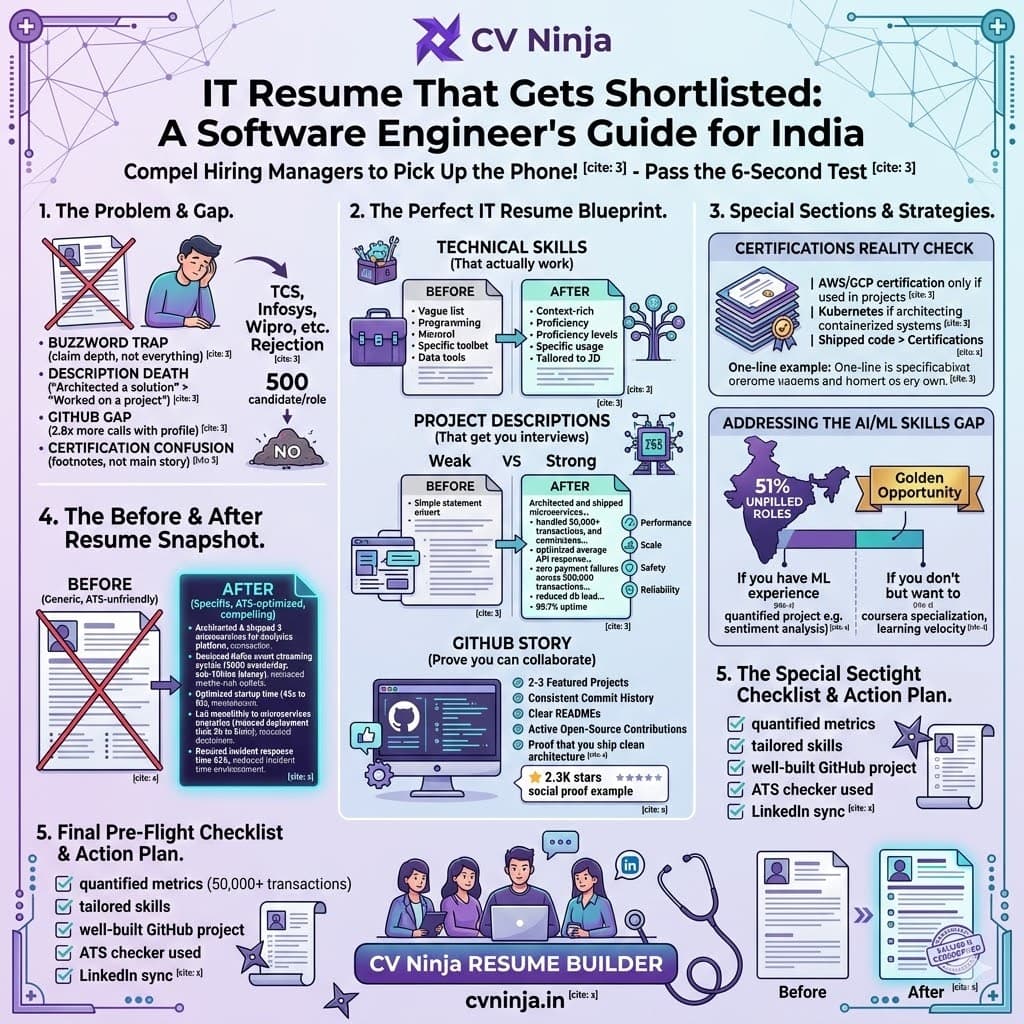
The Buzzword Trap: They list "C++, Java, Python, JavaScript, React, Node.js, AWS, Docker, Kubernetes, Microservices, REST APIs" like they're reciting a litany of mantras. The ATS loves it initially, but the hiring manager sees someone who claims expertise in everything and therefore has depth in nothing.
The Description Death: "Worked on a project using Java and Spring Boot" tells me nothing. Was it a microservice handling 100,000 requests per second? Did you optimize queries to reduce database load by 40%? Did you implement caching that cut API response times in half? The difference between "worked on a project" and "architected a solution that improved system performance by 40%" is the difference between a rejection and a first-round interview.
The GitHub Gap: You're a software engineer in 2026 with no GitHub profile listed. That's like being a designer without a portfolio. Your GitHub isn't just code—it's proof that you ship, that you care about clean architecture, that you can collaborate.
The Certification Confusion: You list CompTIA A+, Google Cloud Associate, and AWS Solutions Architect certifications but didn't mention the startup where you actually deployed on AWS. Certifications are footnotes, not the main story.
This is where 80% of IT resumes fail. Let's fix it.
Section 1: The Technical Skills Section That Actually Works
Here's what doesn't work:
SKILLS
Languages: C++, Java, Python, JavaScript, Go, Rust
Frameworks: Spring Boot, React, Angular, Vue.js, Django
Databases: MySQL, PostgreSQL, MongoDB, DynamoDB, Redis
Cloud: AWS, GCP, Azure
DevOps: Docker, Kubernetes, Jenkins, GitHub Actions
Tools: Git, JIRA, VS Code, IntelliJ
Here's what does:
TECHNICAL SKILLS
Languages: Python (Expert), Java (Advanced), JavaScript (Advanced), Go (Intermediate)
Backend Frameworks: Django, Spring Boot, FastAPI—shipped 3+ production systems
Frontend: React.js, Tailwind CSS—optimized bundle size from 450KB to 180KB
Databases: PostgreSQL (query optimization), Redis (caching strategies), MongoDB
Cloud & DevOps: AWS (EC2, RDS, S3, Lambda), Docker, Kubernetes, CI/CD pipelines
ML/Data: TensorFlow, scikit-learn, pandas, Jupyter (structured models for NLP classification)
Notice the difference? Each technology is paired with context. "Python (Expert)" means you can design systems in Python, not just write scripts. "React.js—optimized bundle size from 450KB to 180KB" shows you understand performance.
Pro Tip: Tailor your Technical Skills section to the job description. If the job asks for React, put it at the top. If it's a backend role, emphasize backend frameworks. The ATS is looking for these exact keywords in order of importance.
Section 2: The Project Descriptions That Get You Interviews
This is where 40% of IT resumes lose the game.
Bad Example:
E-Commerce Platform | Java, Spring Boot, PostgreSQL, AWS
Developed a full-stack e-commerce platform using Spring Boot and AWS.
Good Example:
E-Commerce Platform | Java, Spring Boot, PostgreSQL, AWS, Redis | Feb 2023 – Aug 2024
Architected and shipped a microservices-based e-commerce platform handling 50,000+ daily transactions.
• Designed PostgreSQL schema for normalized product catalog; optimized queries reduced average API response time from 850ms to 180ms through strategic indexing
• Implemented Redis caching layer for product searches, reducing database load by 62% during peak traffic periods
• Built payment integration (Razorpay, Stripe) with transactional safety; zero payment failures across 500,000+ transactions
• Deployed on AWS (EC2, RDS, CloudFront) with auto-scaling groups; system maintained 99.7% uptime during Diwali peak (10x traffic surge)
• Mentored 2 junior developers; conducted 15+ code reviews on architecture patterns
GitHub: github.com/username/ecommerce-platform | 2.3K stars, 45 forks
See the difference? The second example:
- Quantifies impact (50,000+ daily transactions, 62% reduction, 99.7% uptime)
- Shows before/after metrics (850ms → 180ms, 10x traffic surge)
- Proves full-stack capability (architecture, database optimization, deployment, mentoring)
- Includes GitHub link with social proof (stars and forks)
For every project, answer these questions in your bullets:
- What problem did you solve? (performance, scalability, security, user experience)
- What was the business impact? (revenue, users, reliability, cost savings)
- What did you personally own? (the specifics of what you built, not the team)
- What's the proof? (GitHub link, production metrics, user numbers)
Section 3: GitHub Profiles & Open-Source Contributions
In 2026, a software engineer without a GitHub profile is like a chef without recipes.
Your GitHub profile should tell a story:
- 2-3 featured projects that show range: a backend API, a frontend application, a data analysis project
- Consistent commit history (not all commits on weekends; companies notice)
- Clear README files (if your repo has no README, 90% of visitors leave without looking at the code)
- Active open-source contributions (even 3 PRs merged in reputable projects like Flask, requests, or indie libraries matter)
If you're worried about your GitHub looking sparse, start now. Pick a problem you solve daily—expense tracking, portfolio tracking, PDF manipulation—and build it. Not for Instagram, for yourself. Make it good.
Reality Check: You don't need 50 repositories. You need 3 repositories that are so well-built that they make hiring managers lean back and say, "This person ships good code." Open-source contributions aren't required, but they're a superb differentiator if you have them.
Section 4: The Certifications Reality Check
A confession: most IT certifications don't matter. AWS Solutions Architect? Great for salary negotiation. Google Cloud Associate? Good to have. CompTIA A+? That's 2010-era relevance.
What matters:
- AWS/GCP/Azure certification only if you actually use it in projects
- Kubernetes certification only if you architect containerized systems
- Nothing else matters as much as shipped code
One line in your resume:
AWS Solutions Architect Associate (certified 2024) | Deployed 8 microservices on AWS in 2024
Not:
AWS Solutions Architect Associate
Google Cloud Associate
Azure Fundamentals
Kubernetes Administrator (in progress)
HashiCorp Certified Terraform
Section 5: Addressing the AI/ML Skills Gap
Here's a golden opportunity. 51% of AI/ML roles in India remain unfilled. Only 16% of IT professionals claim AI skills. If you can credibly claim ML experience, you're in the top percentile.
How to position AI/ML skills credibly:
If you have ML experience:
Machine Learning Projects
Sentiment Analysis for E-Commerce Reviews | Python, TensorFlow, scikit-learn, FastAPI | 2024
• Built an LSTM-based sentiment classification model; achieved 91% accuracy on 50K+ customer reviews
• Deployed model as REST API using FastAPI; integrated into product platform (1,000 inferences/day)
• Implemented A/B testing to compare LSTM vs. BERT-based models; BERT improved precision by 4%
• Reduced inference latency from 450ms to 120ms through model quantization and caching strategies

GitHub: github.com/username/sentiment-analysis | Dataset: HuggingFace (featured model)
If you don't have ML experience but want to:
LEARNING & PROJECTS
AI/ML Specialization (In Progress) | Coursera Machine Learning Specialization by Andrew Ng
• Completed 4/5 courses; focus areas: supervised learning, neural networks, time series forecasting
• [Optional] Personal project: Predictive house price model (scikit-learn, pandas); 87% R² on validation set
This is honest. Hiring managers value learning velocity, especially in a fast-moving field like AI.
The Before & After Resume Snapshot
BEFORE (Generic, ATS-unfriendly):
WORK EXPERIENCE
Senior Software Engineer | TCS | Jan 2021 – Present
• Developed software solutions for clients using Java and Spring Boot
• Worked on cloud deployment projects using AWS
• Participated in code reviews and mentored junior team members

SKILLS
Java, Python, JavaScript, React, Spring Boot, AWS, Docker, Kubernetes, MySQL, PostgreSQL
AFTER (Specific, ATS-optimized, compelling):
WORK EXPERIENCE
Senior Software Engineer | TCS | Jan 2021 – Present
Architected and shipped 3 microservices powering real-time analytics platform for Fortune 500 financial services client.
• Designed high-throughput event streaming system (Apache Kafka) processing 500K events/day; achieved sub-100ms latency
• Optimized Spring Boot application startup time from 45s to 8s through lazy initialization and container optimization
• Led migration from monolithic Spring MVC (2M LOC) to microservices; reduced deployment time from 2 hours to 8 minutes via Docker + Kubernetes
• Architected AWS infrastructure (VPC, RDS, ElastiCache); designed auto-scaling policies for 10x traffic spikes
• Mentored 4 engineers on system design; conducted architecture reviews for 12+ projects
• Reduced on-call incident response time by 65% through structured logging (ELK stack) and monitoring (Prometheus/Grafana)

GitHub: github.com/username/portfolio | 850 stars across top repositories
The ATS Optimization Layer
ATS systems look for:
- Exact keyword matches from job description (if the job asks for "Kubernetes," have "Kubernetes" in your resume, not just "container orchestration")
- Reverse chronological order (most recent first)
- Clear section headers (WORK EXPERIENCE, TECHNICAL SKILLS, PROJECTS, EDUCATION)
- No graphics, tables, or fancy formatting (submit as clean .pdf or .docx)
- Quantifiable metrics (ATS can parse percentages, numbers, timeframes)
Real Numbers That Matter
According to industry data:
- 79% of IT hiring managers reject resumes in the first 10 seconds if they don't see relevant keywords
- 51% of AI/ML roles in India remain unfilled—your window to command premium salaries
- Software engineers with GitHub profiles receive 2.8x more interview calls
- Resumes with quantified impact get 4x more recruiter callbacks
[INTERNAL: /data-science-ai-resume - data science resume guide] for more on positioning AI skills. [INTERNAL: /cv-ninja-aats-score - ATS score checker] to validate your resume format.
Your Action Plan
-
Audit your current resume against the good examples above. How many project bullets include quantified metrics? If fewer than 50%, rewrite them.
-
Build your GitHub story if you don't have one. Start with 1 well-built project. Shoot for 100 lines of clean code rather than 1,000 lines of messy code.
-
Tailor your skills section to the job description. If React is mentioned first in the job post, React should be first in your skills.
-
Get your resume ATS-checked using CV Ninja's ATS Score Checker. A resume with 85%+ ATS compatibility has 10x higher conversion rates.
-
LinkedIn sync your resume projects to your LinkedIn summary. Consistency matters.
The Final Word
India's IT sector is competitive, but it's also hungry. TCS is hiring thousands. Startups are backed by billions in VC. The opportunity is massive—but only for candidates whose resumes prove they can ship production systems, solve real problems, and own their work.
Your resume is your first impression. Make it say: "I build systems that scale. I ship. I own my code. I improve things."
Make every word count.
Ready to get your IT resume noticed?
CV Ninja's AI-powered resume builder helps you craft the exact format that passes ATS checks while impressing hiring managers. Use our resume templates tailored for software engineers, add our ATS Score Checker to validate your work, and leverage our skills gap analysis to identify which technologies you should focus on next.
Start with our free resume builder today—no credit card needed—and get shortlisted faster. Visit CV Ninja
Continue Reading

Ready to Build Your Resume?
Create a professional, ATS-friendly resume in minutes with CV Ninja's AI-powered resume builder.
Get Started Free